Where The Map Ends
Week ending Friday 3 July 2026
There was a time when every driver kept a street directory in the glovebox.
It was indispensable.
Today, it would still show you where the roads are.
But it couldn’t tell you which ones are closed.
Nor would it warn you about traffic or reroute you around an accident.
The map hasn’t become wrong.
It has become incomplete.
Much of this week’s economic commentary felt the same.
Economists, politicians and commentators kept reaching for yesterday’s models to explain today’s events.
Falling house prices should trigger mortgage stress.
Weaker spending should tame inflation.
Rising property prices should make us wealthier.
Yet the evidence increasingly points elsewhere.
This week’s stories weren’t really about housing.
They were about the danger of navigating new terrain with an old map.
When Wealth Isn’t Wealth
The Reserve Bank is becoming increasingly concerned about falling house prices.
Because of a known link between consumer spending and house values.
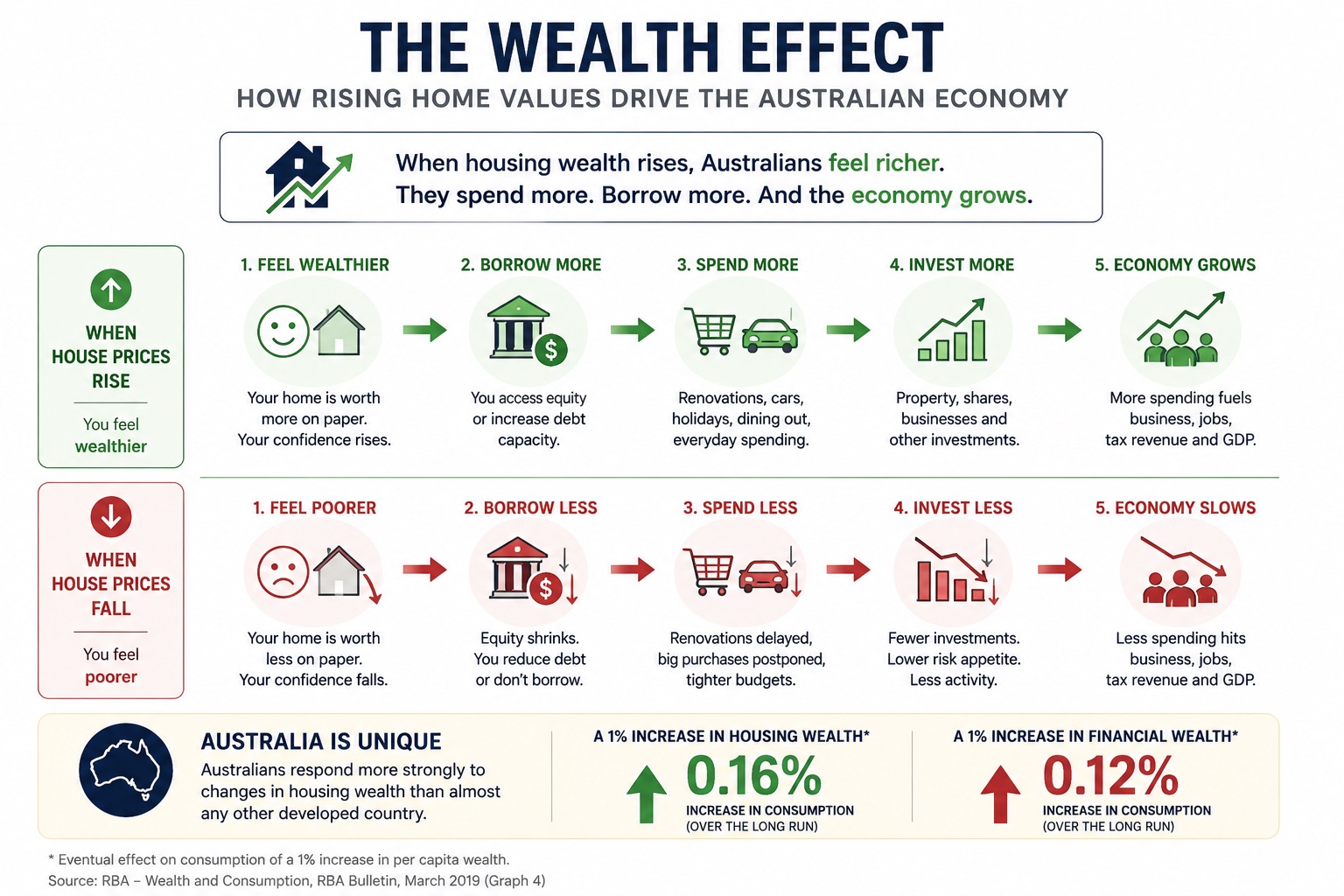
For years Australia has relied on what economists call the wealth effect.
When people believe their homes are worth more, they feel wealthier. They renovate, buy new cars, invest, borrow against their equity and spend more freely.
The RBA has long acknowledged the relationship. Its own research concluded that rising housing wealth increases household consumption. In Australia, rising house prices have become less a reflection of economic prosperity and more a driver of it.
That is an uncomfortable admission.
An economy built on continually rising asset prices eventually reaches a point where those prices cannot keep rising forever.
And when they stop…
Consumption slows.
Confidence weakens.
The economy itself begins to feel fragile.
The Canadian Contradiction
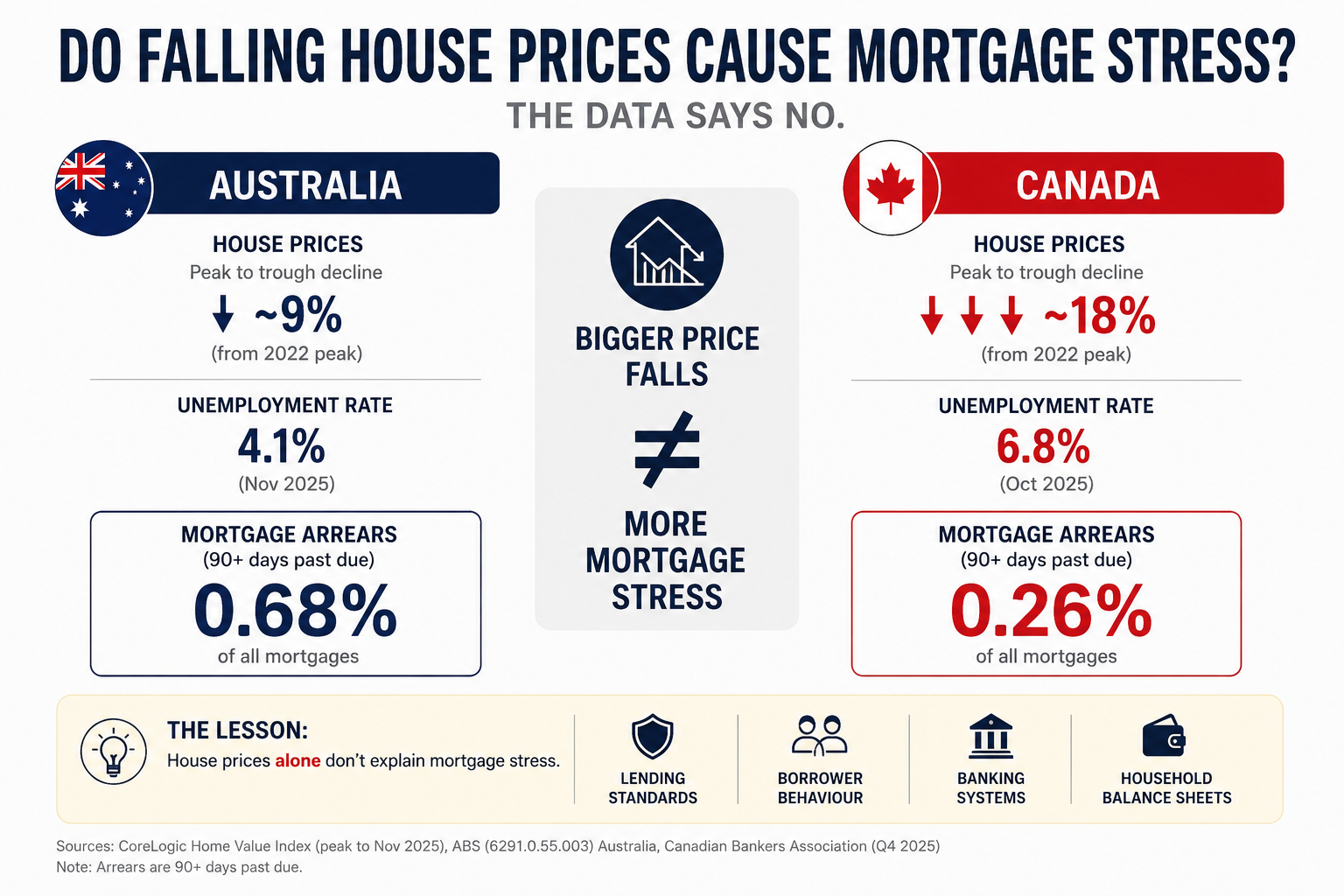
Conventional wisdom says falling house prices inevitably lead to mortgage stress.
Canada suggests otherwise.
Canadian house prices have experienced a much sharper correction than Australia’s.
Unemployment has risen further.
Migration has slowed dramatically.
Yet mortgage arrears remain materially lower than Australia’s.
That should make us pause.
Perhaps house prices alone were never the right measure of financial health.
Perhaps lending standards, household balance sheets, borrower behaviour and banking systems matter far more than headline price movements.
Markets rarely punish people for asking difficult questions.
They punish those who stop asking them.
Our National Obsession
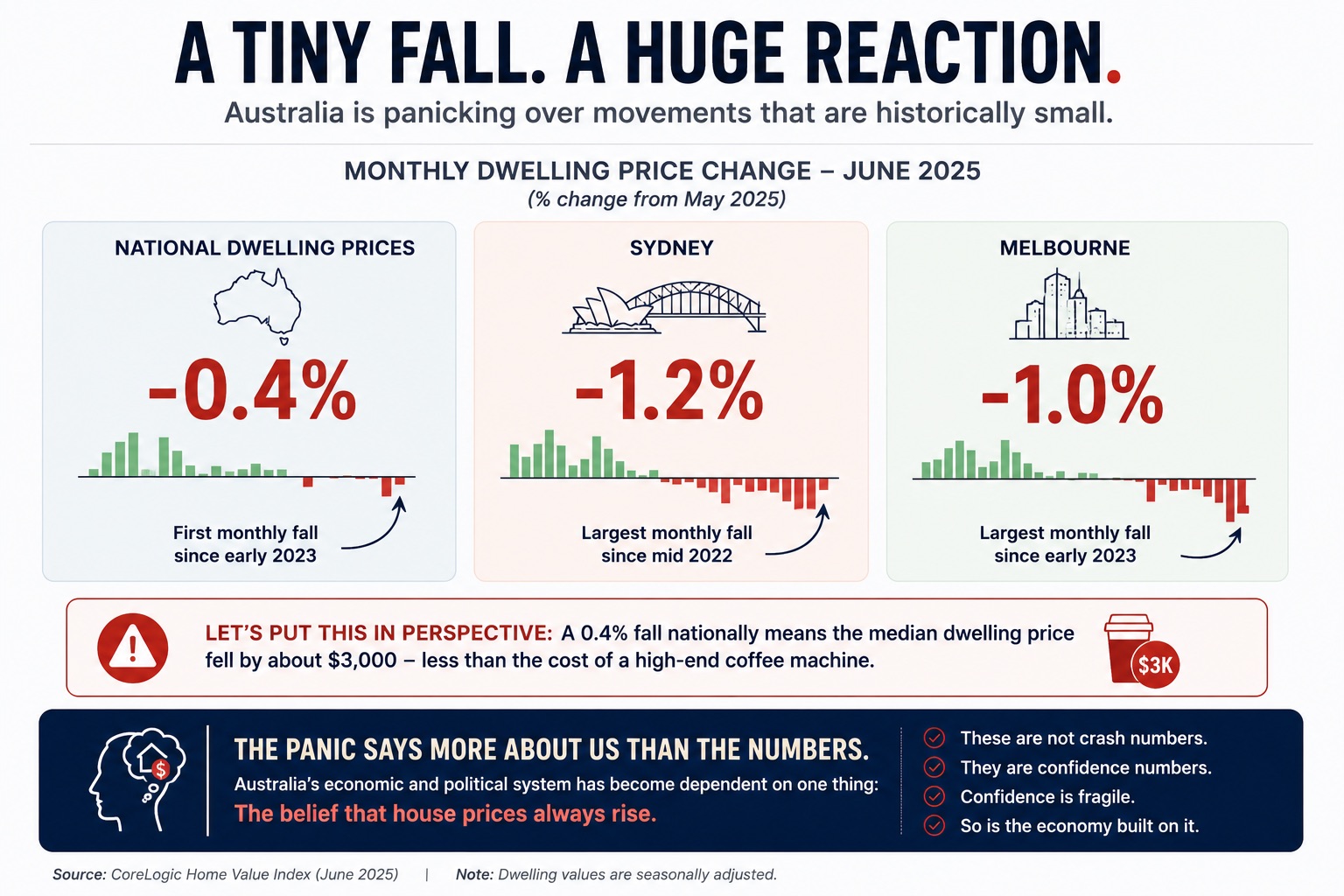
This week national headlines were dominated by a 0.4% fall in dwelling prices.
Not four percent.
Less than half of one percent.
Imagine similar headlines because televisions became cheaper.
Or laptops.
Or furniture.
We would celebrate.
Competition is working.
Consumers benefit.
Yet property occupies a different place in Australia’s psyche.
Every small decline becomes a national conversation.
Politicians respond.
Economists revise forecasts.
Media outlets speculate endlessly about crashes, recoveries and turning points.
Somewhere along the way we stopped treating housing as shelter and started treating rising prices as an economic objective in themselves.
Perhaps that’s why every modest correction feels like a crisis.
Not because it changes much today.
But because it challenges a story Australians have believed for decades.
That house prices are supposed to rise.
Always.
The Inflation Puzzle
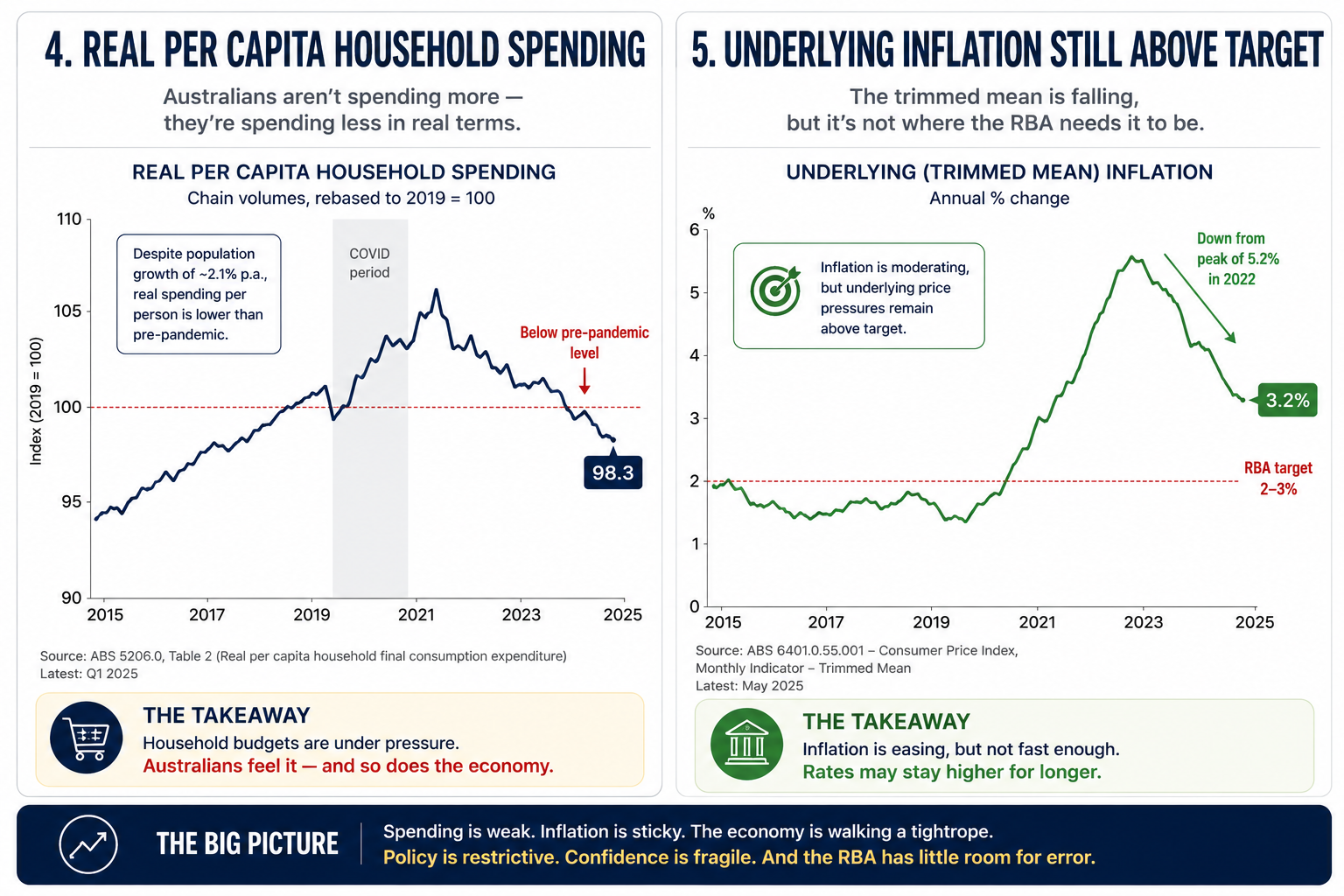
At the same time households continue tightening their belts.
Real spending has been weakening for years.
Consumers have been absorbing higher interest rates.
Higher energy costs.
Higher insurance premiums.
Higher taxes.
Higher mortgage repayments.
By the textbook, inflation should be fading.
Instead, it refuses to cooperate.
The Reserve Bank now finds itself confronting an uncomfortable possibility.
It may take even weaker economic conditions to finally bring inflation under control.
Think about that.
Australians have already been spending less.
Living standards have already been squeezed.
Yet inflation continues to linger.
Perhaps the old relationship between demand and inflation isn’t as simple as it once appeared.
Or perhaps other forces—energy, supply constraints, government spending and structural change—now matter far more than many models assume.
The Operator’s Edge
Markets become inefficient when people keep interpreting new information through outdated beliefs.
That’s what this week revealed.
The headlines were all different.
House prices.
Mortgage arrears.
Inflation.
Consumer spending.
But underneath them sat the same assumption.
That yesterday’s relationships still explain today’s economy.
Sometimes they do.
Increasingly, they don’t.
Operators understand something different.
The goal isn’t to predict the future.
It’s to recognise when the map everyone else is using no longer matches the terrain.
If weaker house prices don’t automatically produce mortgage crises…
If weaker spending doesn’t automatically tame inflation…
If rising house prices don’t necessarily make a nation wealthier…
Then opportunity lies not in following the crowd’s conclusions, but in questioning the assumptions that produced them.
As George Box famously observed:
“All models are wrong. Some are useful.”
The trick is knowing when a useful model has reached the end of its usefulness.
Because the biggest investment mistakes are rarely caused by a lack of information.
They’re caused by clinging to a map long after the landscape has changed.
The road ahead hasn’t changed nearly as much as the assumptions we’re using to navigate it. And smart operators know that tomorrow’s opportunities rarely appear on yesterday’s map.
Which map are you using?
