Follow The Money
Week ending Friday 7 August 2026
The Day the Property Market Froze
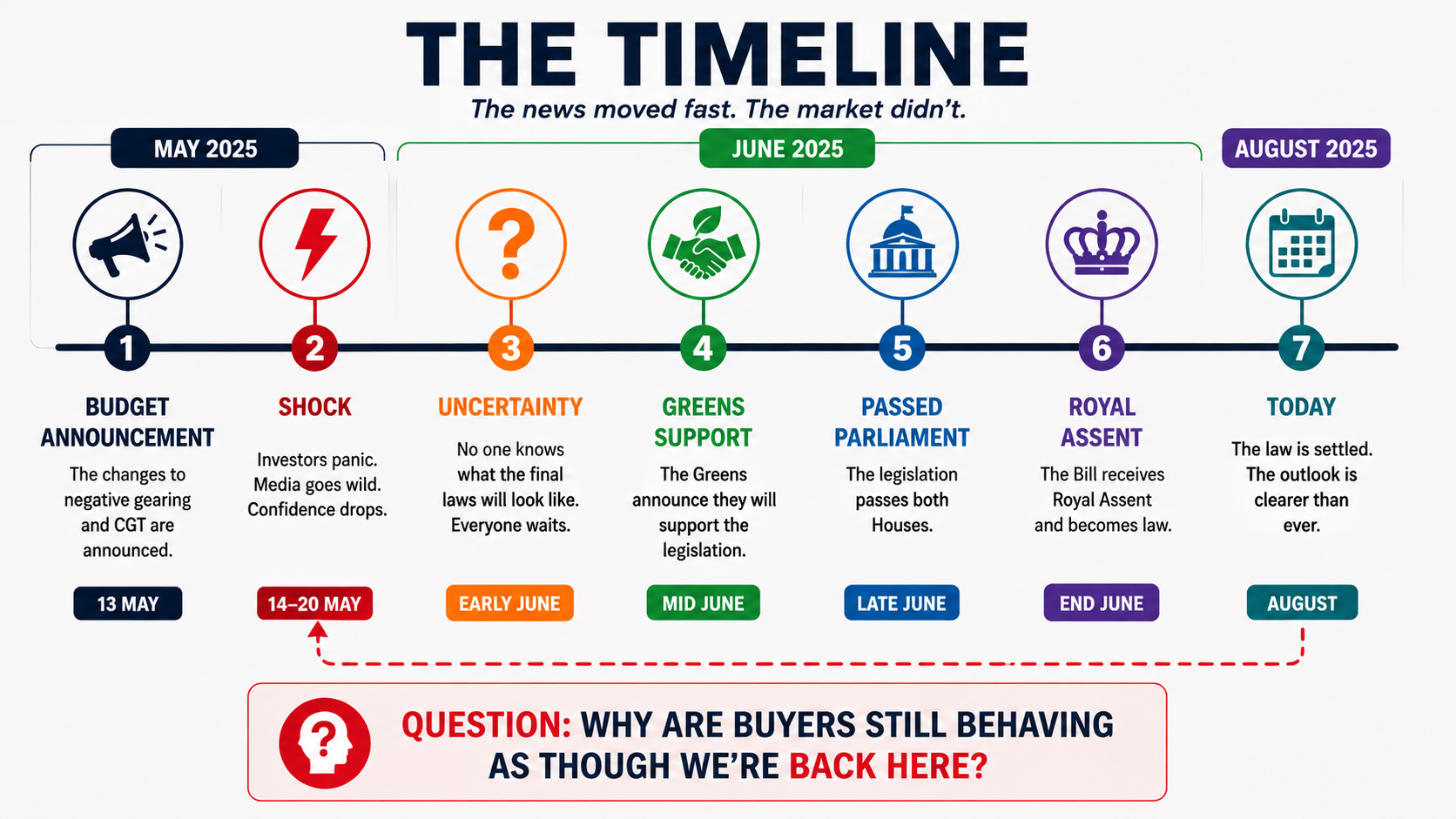
Back in May, the property market hit the brakes.
The Federal Budget proposed sweeping changes to negative gearing and capital gains tax.
Nobody knew what would happen next.
Would the legislation pass?
Would the Greens support it?
Would the Government water it down?
Would there be amendments?
Nobody knew.
Investors paused.
Buyers hesitated.
The media filled the vacuum with speculation.
Frankly, that was a perfectly rational response.
But then something interesting happened.
The legislation passed both Houses of Parliament.
It received Royal Assent.
The broad direction became law.
Yes, there are still technical amendments being worked through around the edges, but the central question—Will these reforms happen?—has largely been answered.
And yet...
The market still feels like it's trapped back in May.
It's behaving as though the uncertainty is still unfolding.
As though the outcome is still unknown.
As though everyone is still waiting for the next headline.
But what if the headlines have moved on... and the market hasn't?
Facts Change First. Behaviour Changes Later.
Markets are funny things.
The facts can change overnight.
People don't.
Once uncertainty takes hold, it tends to linger long after the reason for it has disappeared.
Think about almost any major event.
Covid Restrictions end.
People still hesitate to travel.
Interest rates stop rising.
People still expect another increase.
The rules become clear.
People still behave as though they're uncertain.
Property is no different.
Today, two of the biggest unknowns are no longer quite so unknown.
The broad direction of the tax reforms is now settled.
At the same time, the Reserve Bank's language has become noticeably more measured.
Governor Michele Bullock has acknowledged that higher interest rates are working their way through the economy, inflation is easing and weaker consumer demand is doing exactly what higher rates were designed to achieve. The Board has increasingly shifted from asking "How much higher?" to "How long should rates remain where they are?"
That's a very different conversation.
It doesn't mean every uncertainty has disappeared.
Far from it.
But it does mean some of the biggest question marks hanging over the property market (and indeed the catalyst for buyers and sellers both pushing the pause button to wait and see) are no longer as large as they were only a few months ago.
We have waited, and we have seen, and now there is far more clarity ...
And yet...
Consumer confidence remains weak.
Buyers are still waiting.
The mood hasn't caught up with the facts.
Behaviour almost always lags reality.
Which made us wonder...
If the biggest fears are no longer getting bigger... why is everyone still looking backwards?
That was the question that sent us down a completely different path.
Instead of asking what people were afraid of...
We started asking a different question.
What is the Government preparing for?
Follow the Money
Governments don't just pass laws.
They write budgets.
And budgets reveal priorities.
If you want to understand where politicians think the country is heading...
Don't just read what they tax.
Watch closely what they fund.
So we did.
And a pattern started to emerge.
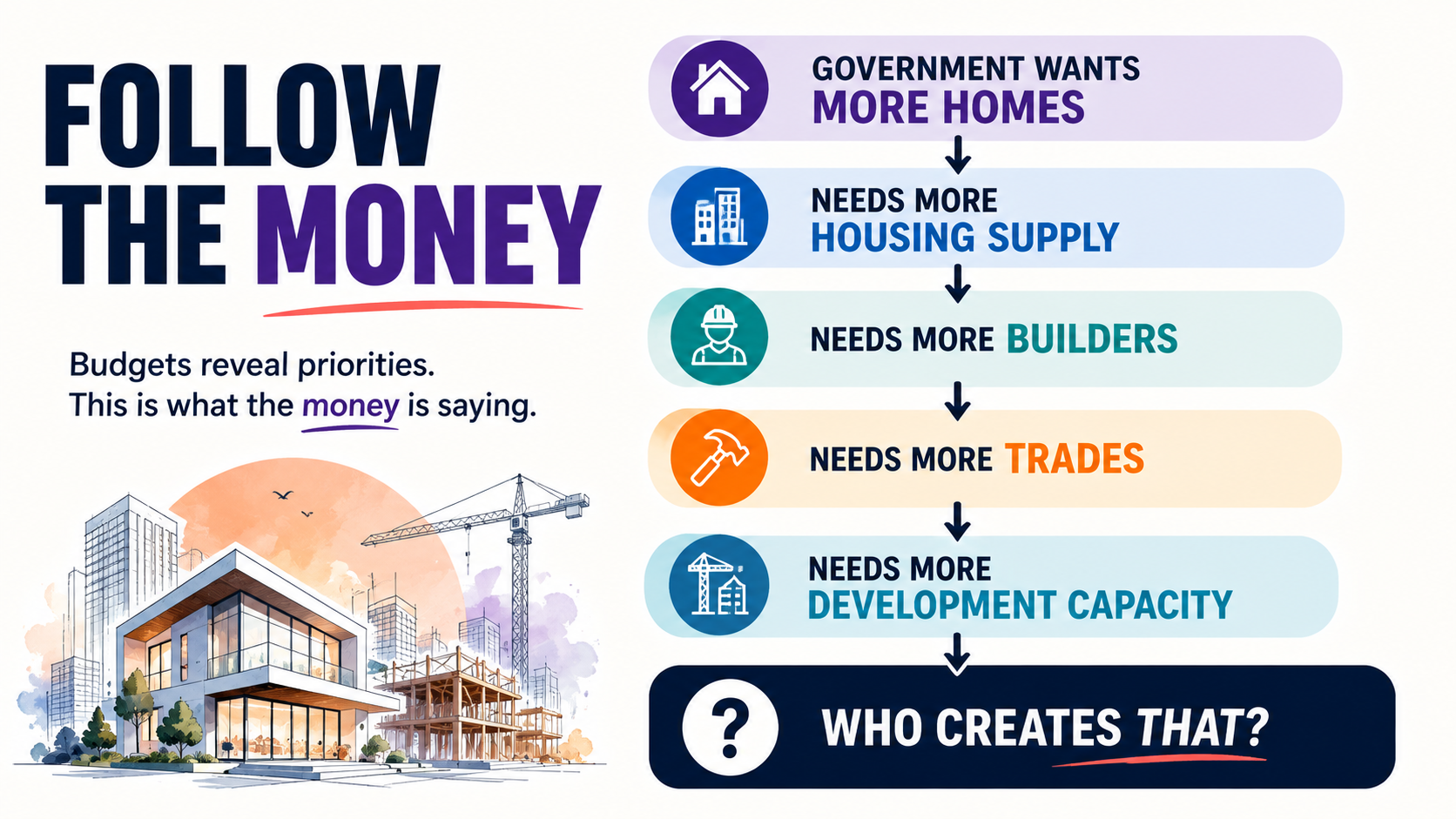
The Government has made Free TAFE permanent for many construction courses.
Why?
Because Australia doesn't have enough people to build the homes it needs.
It has increased incentives for construction apprentices.
Why?
Because there aren't enough apprentices entering the residential building industry.
It's looking at skilled migration pathways to attract more qualified construction workers.
Why?
Because even with more apprentices, there still aren't enough tradespeople.
It's investing in modern construction methods, including modular housing.
Why?
Because traditional construction alone isn't delivering homes quickly enough.
At first, these looked like separate announcements.
They're not.
They're all solving the same problem.
Australia doesn't have a demand problem.
It has a supply problem.
That's why the Government isn't just changing tax policy.
It's investing billions trying to increase the country's capacity to create more housing.
That's when we realised something.
The media is still asking whether property is a good investment.
The Government appears to be asking a very different question.
Who is going to build the homes Australia needs?
Which is a completely different conversation.
So We Decided To Test It
A thesis is only as good as its ability to predict reality.
If we were right…
If today’s market is suffering more from a confidence lag than a property problem…
If fear is causing good opportunities to be overlooked…
Then we should still be able to find them.
Not six months from now.
Today.
So we ran an experiment.
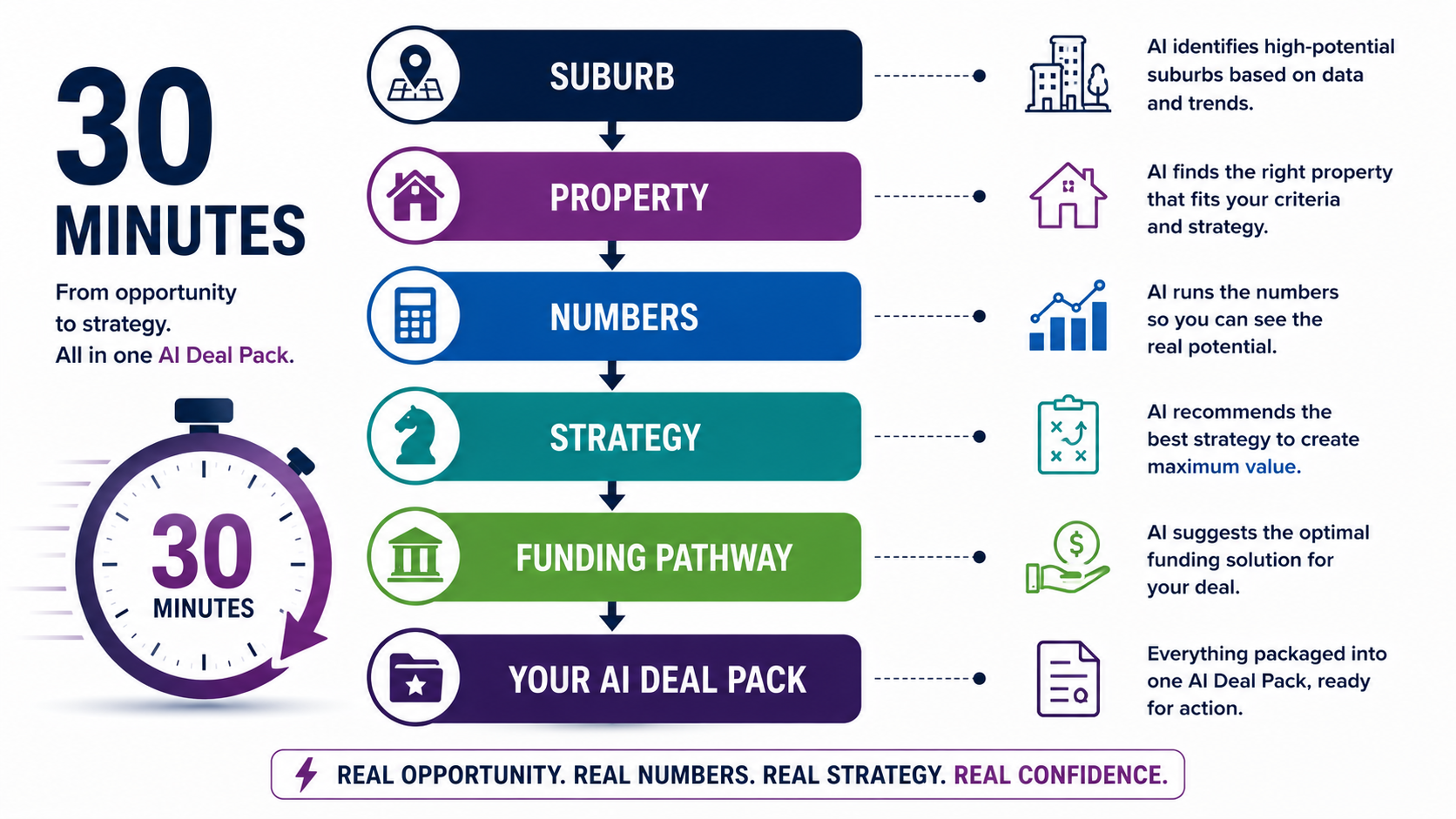
We asked AI to do what most people spend days—sometimes weeks—doing by hand.
Find a suburb.
Find a property.
Run the numbers.
Build a value-add strategy.
Map a funding pathway.
Package everything into a single Deal Pack.
Honestly…
We expected it to struggle.
It didn’t.
In under 30 minutes, we had a complete opportunity to evaluate.
Not a headline or an opinion.
A real property.
Actual numbers.
And a clear strategy.
That was the surprise.
The conversation suddenly changed.
We stopped asking, “Is now the right time to buy property?”
We started asking, “Does this opportunity stack up?”
Those are quite different questions.
Perhaps that’s the lesson.
Confidence rarely returns because someone writes a positive headline.
It returns when uncertainty is replaced with evidence.
The market may still be nervous.
But the numbers don’t have emotions.
They either work…
Or they don’t.
Perhaps that’s where the next cycle begins.
Not with optimism.
With someone quietly doing the work while everyone else is still debating the headlines.
