The Madness of Markets
Week ending Friday 17 July 2026
Sir Isaac Newton could predict the movement of planets with astonishing precision.
Yet after losing a fortune in one of history's greatest speculative bubbles, he reportedly remarked:
"I can calculate the motions of the heavenly bodies, but not the madness of men."
More than three hundred years later, economists are still trying.
Every week we're presented with charts showing inflation, interest rates, employment, consumer confidence and house prices. We treat the economy as though it's a giant machine. Pull one lever and another gear turns.
Raise interest rates and spending falls.
Lower rates and property rises.
Reduce supply and prices increase.
Simple.
Except it rarely is.
Because markets aren't machines.
They're people.
And people don't behave like equations.
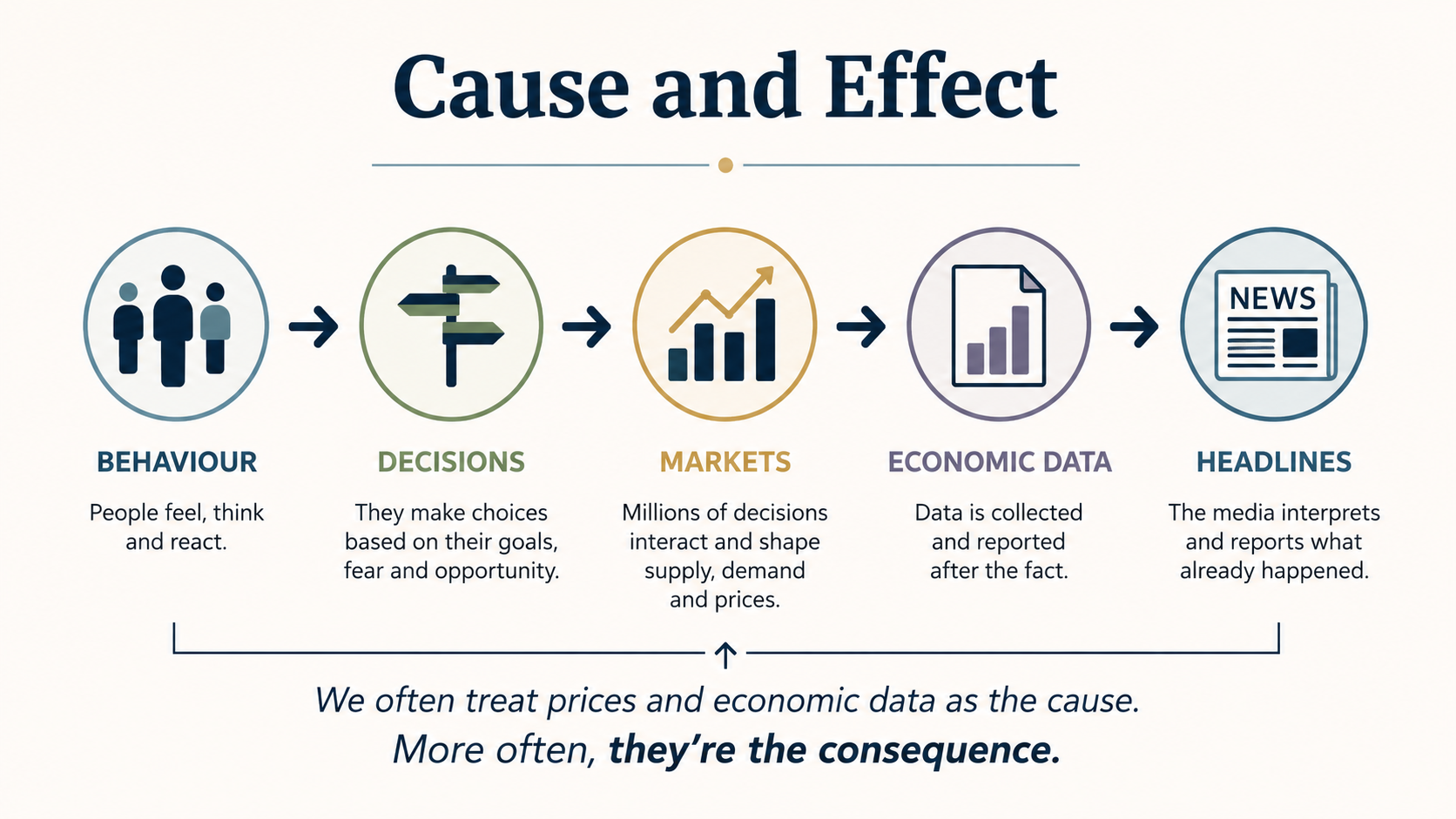
Behaviour Changes First
History tells a remarkably consistent story.
The biggest economic shifts rarely begin with economics.
They begin with human behaviour.
The Great Depression wasn't simply a stock market crash.
It became a depression because fear spread through society. People stopped spending. Banks stopped lending. Businesses stopped investing. Families hoarded cash.
The behavioural shift created the economic collapse.
During World War II, entire economies transformed almost overnight. Women entered the workforce in unprecedented numbers. Industries reinvented themselves. Governments intervened at a scale never seen before.
Many of those behavioural changes permanently reshaped society long after the war had ended.
COVID was no different.
Many experts predicted a collapse in property prices.
Instead, millions of Australians suddenly valued an extra bedroom, a home office, a backyard and the freedom to work remotely.
The market didn't create those priorities.
People did.
Only then did prices move.
Markets don't change first.
People do.
The Most Dangerous Assumption In Economics
Which brings us to the obvious elephant in the room.
Every economic policy rests on one fundamental assumption.
That people will behave the way policymakers expect.
This week's housing and lending data provides an interesting example.
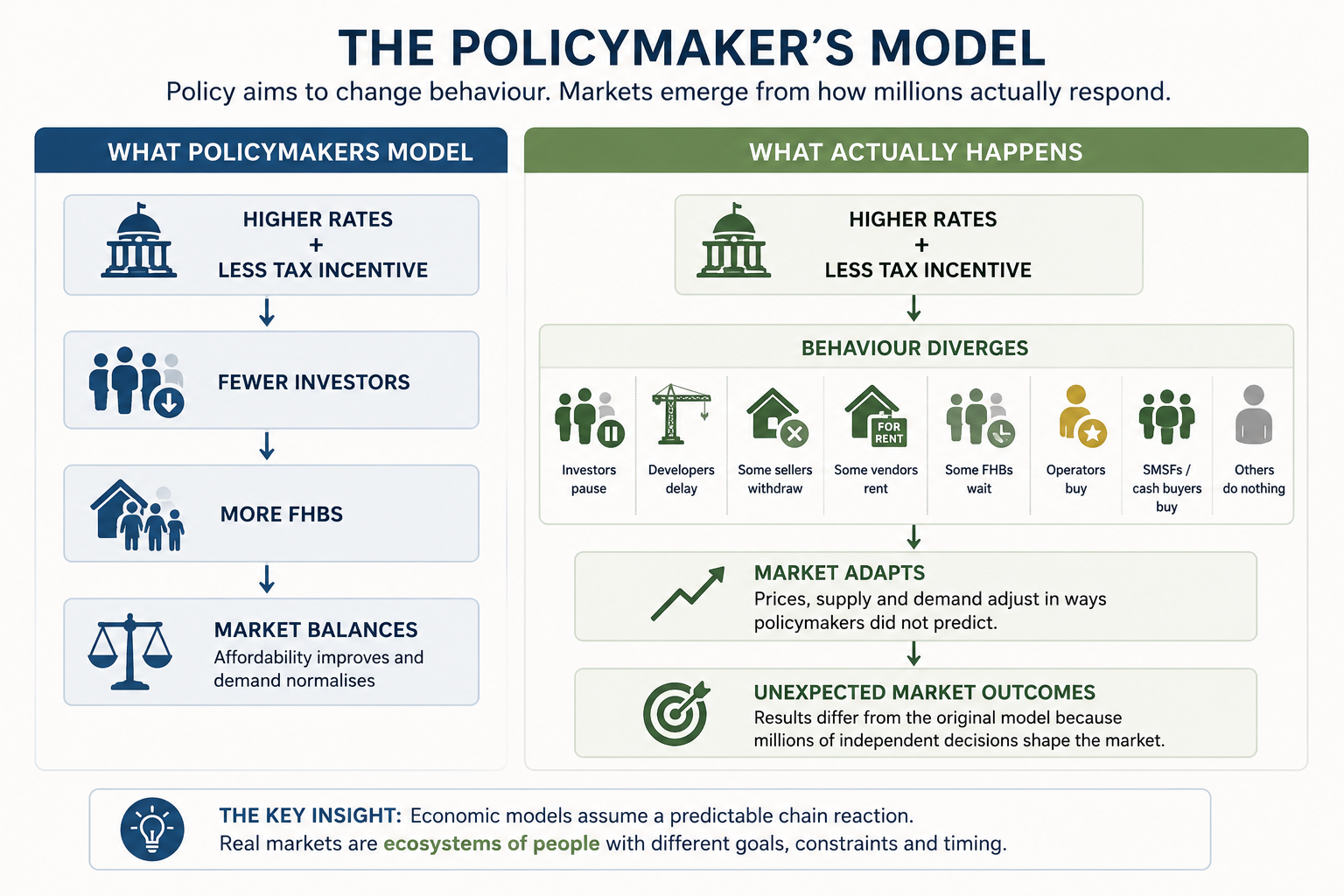
The Federal Budget introduced significant housing measures intended to improve affordability and help more Australians into home ownership.
Whether those policies were right or wrong isn't really the point.
The more relevant question is this:
What assumptions did they make about human behaviour?
Implicitly, much of the commentary assumed something like this:
Investors buy less.
First-home buyers buy more.
The market rebalances.
Logical, neat and almost mathematical.
But markets aren't relay races.
Removing one participant doesn't automatically mean another is ready to take their place.
Perhaps first-home buyers are still waiting for another interest rate cut.
Or maybe they're worried about job security.
Or else they're still struggling to obtain finance.
It could even be that they simply don't feel confident enough to buy.
Whatever the reason, the latest lending figures suggest behaviour hasn't unfolded quite as many expected.
And that's the difficulty with markets.
Governments can change incentives.
But they can't determine how millions of individuals will respond.
The Wild Card
Perhaps the biggest assumption of all was that policymakers thought that there were only two groups worth considering.
Investors.
And first-home buyers.
But markets are ecosystems - not equations.
When one group hesitates, another often sees opportunity.
Which raises another possibility.
While some first-home buyers are sitting back to see how policy will unfold...
Will operators step forward?
Not because they know what will happen - nobody does.
But because uncertainty often reduces competition.
Fewer bidders.
More negotiable vendors.
Less emotion.
Greater opportunity.
It's impossible to know how much influence that will have.
But history suggests markets rarely leave a vacuum unfilled for long.
Someone almost always steps into the space.
Perhaps that's why some of the best opportunities emerge when everyone else is waiting to see what others will do.
Look again at this week's news.
Auction clearance rates remain weak.
Consumer spending has slowed despite heavy discounting at EOFY sales.
Home ownership continues to fall.
Each story is presented as though the market itself has changed.
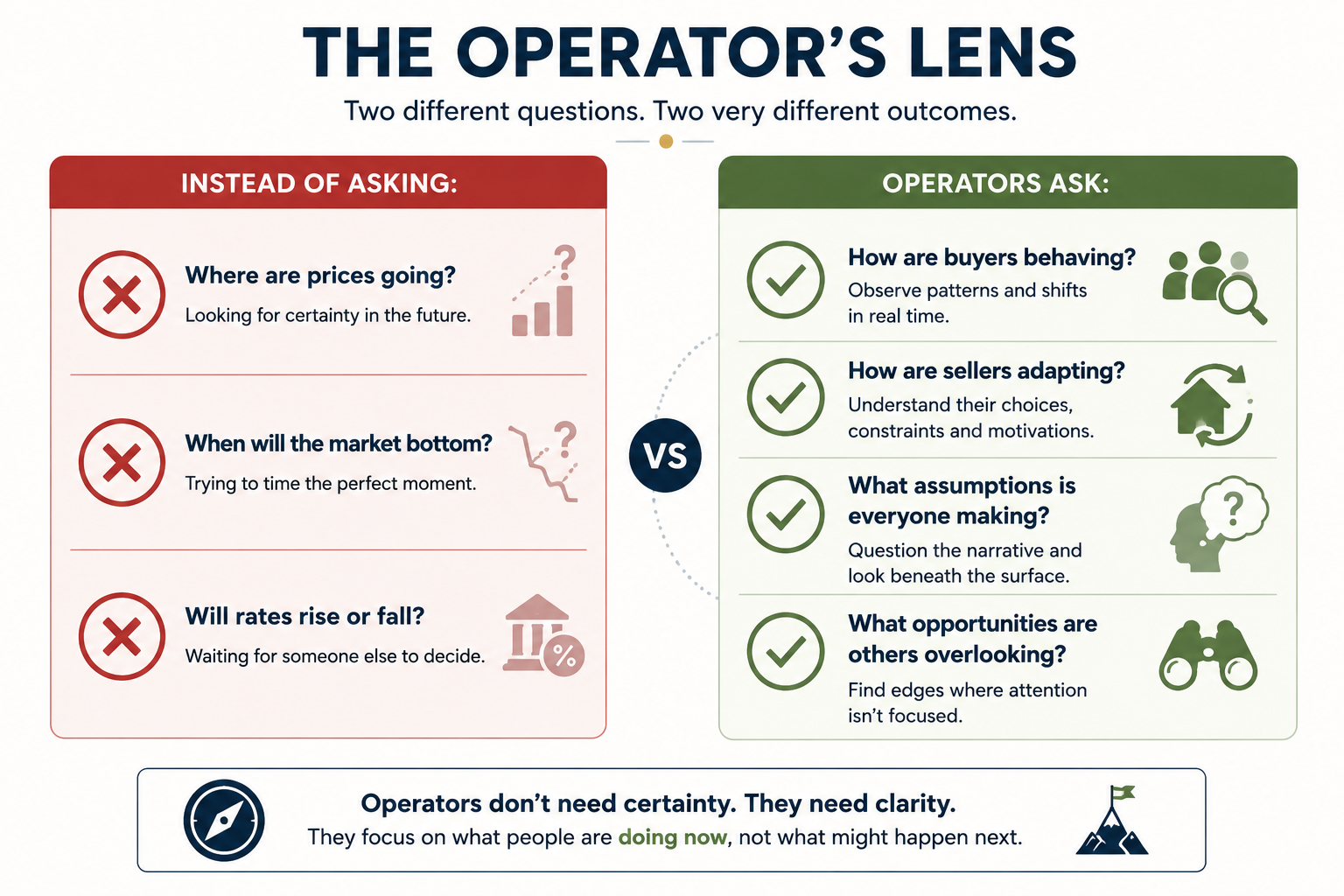
Operators ask a different question.
How have people changed?
When auctions become harder, sellers don't automatically slash their prices.
Some withdraw their properties.
Others rent them instead.
Some accept pre-auction offers.
Many simply wait.
Consumers are behaving differently too.
They're spending less in some areas while continuing to spend heavily in others.
The headlines describe outcomes.
Operators investigate behaviour.
Watching The Players, Not The Scoreboard
The late, great investor, Jesse Livermore, once observed:
"The market is never wrong. Opinions often are."
He understood something many investors still miss.
Prices don't predict behaviour.
They reflect behaviour that has already occurred.
By the time auction clearance rates fall...
Buyers and sellers have already changed.
When it actually becomes evident that retail spending has weakened...
consumers have already changed.
When economists realise it's time to revise their forecasts...
the behavioural shift is already underway.
Prices are evidence.
Not causes.
This Week's Edge
Perhaps the real lesson from this week's news isn't about auctions.
Or interest rates.
Or consumer spending.
It's about assumptions.
Every forecast, budget, interest rate decision and market prediction.
They're all built on assumptions about what people will do next.
Sometimes those assumptions are right.
Sometimes they're not.
Because markets aren't governed by equations.
They're actually governed by millions of independent decisions made by people with different goals, different fears, different constraints and different opportunities.
Governments can change policy.
Central banks can change interest rates.
Economists can change their forecasts.
But none of them control the market.
The market is simply the sum of millions of individual emotions driving behaviours.
And that's precisely where operators look.
Because while everyone else is trying to predict what people will do...
Operators are already deciding what they'll do themselves.
