The Price of Consensus
Week ending Friday 19 June 2026
Warren Buffett once observed:
“You pay a very high price for a cheery consensus.”
The same principle applies well beyond the stock market.
Whenever everyone agrees, the opportunity is usually gone.
This week provided a masterclass.
The media debated whether property prices are falling.
Economists debated whether the Reserve Bank should cut rates.
Politicians debated whether they had gone too far on tax reform.
Investors debated whether now was the right time to buy.
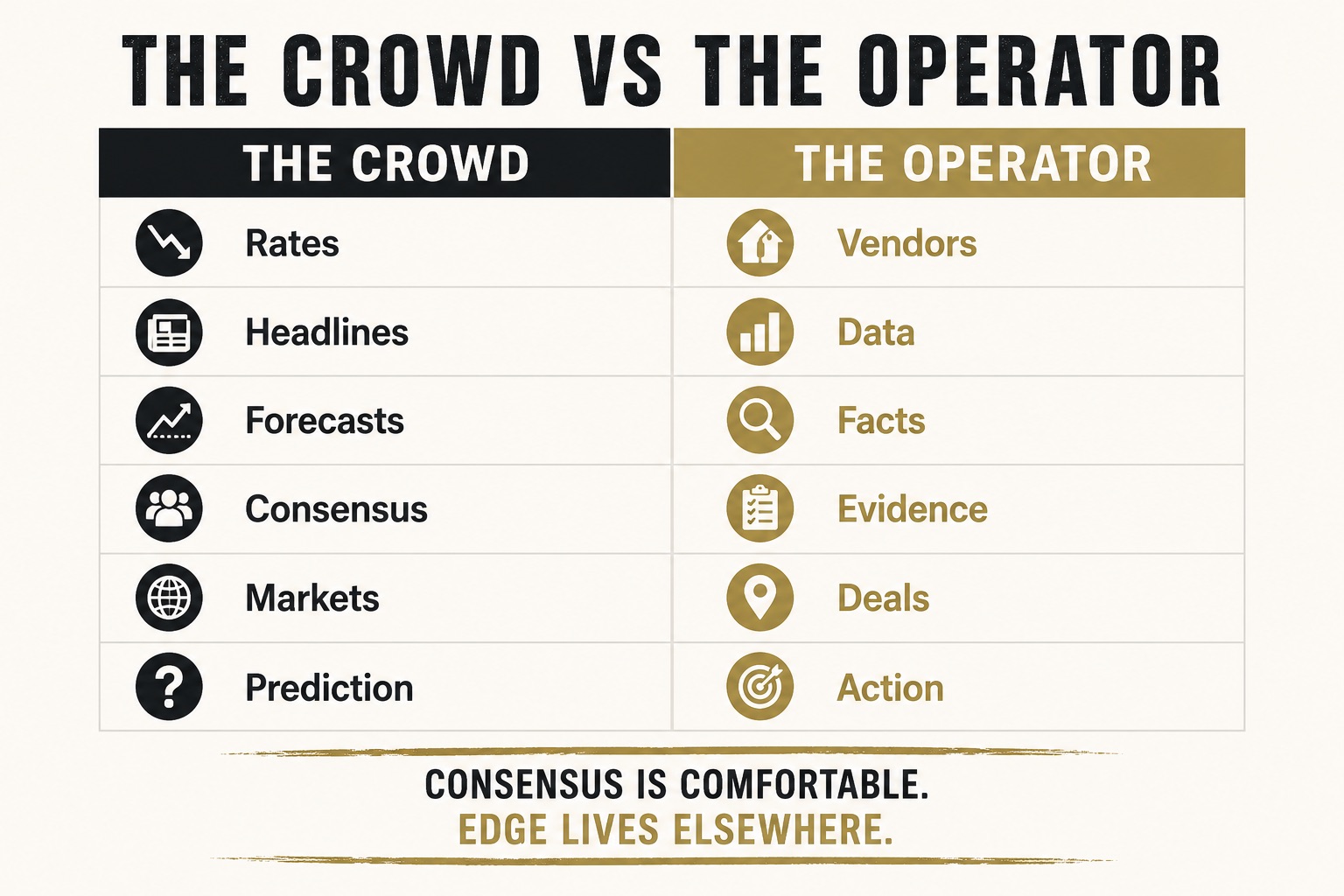
The crowd is trying to agree on what happens next.
Operators are trying to understand what is happening now.
The Quest For Certainty
The week kicked off with a debate over whether property prices have further to fall.
Analysts revised forecasts lower. Buyers began discussing whether now was the time to wait for “the bottom”.
The trouble with bottoms is that they only become obvious after they’ve passed.
Nobody recognised the bottom in Sydney in 2012.
Nobody recognised the bottom after COVID.
The people buying at those moments looked early.
The people waiting felt prudent.
History tends to remember them differently.
The second debate that surfaced this week centred on Australia’s emerging buyers’ market.
A curious phrase.
If it is a buyers’ market, why aren’t buyers feeling it?
Because buyers and sellers are still arguing about the future.
The seller remembers yesterday’s price.
The buyer worries about tomorrow’s price.
Meanwhile, reality carries on with little regard for either forecast.
Billionaire investor George Soros once observed that markets have a peculiar habit of being driven by people’s beliefs about reality.
When enough people become convinced prices will fall, they stop buying.
When enough people become certain prices will rise, they rush in.
The expectation starts influencing the outcome.
This week felt a little like that.
Everyone trying to predict everyone else’s next move.
The Reserve Bank wasn’t much different.
Rates were left unchanged.m when the RBA met this week.
Not because the future is clear.
But precisely because it isn’t.
The Reserve Bank is waiting for inflation.
Investors are waiting for rates.
Buyers are waiting for prices.
Sellers are waiting for buyers.
Waiting has become the national pastime.
Then Canberra chimed in yesterday with another reminder.
After announcing significant tax changes only weeks ago, parts of the policy are already being softened and revised.
Complex systems rarely move in straight lines.
People react.
Behaviour changes.
Policy changes again.
The future refuses to cooperate with forecasts.
Meanwhile, the crowd continues trying to agree on what happens next.
Will rates fall?
Will prices fall?
Will we have a recession?
Will we avoid one?
Will this be the bottom?
Will there be another one?
None of those questions are unreasonable.
They’re just impossible to answer with any certainty.
Which is why the most successful operators tend to focus elsewhere.
Not on predicting the future.
On understanding the present.
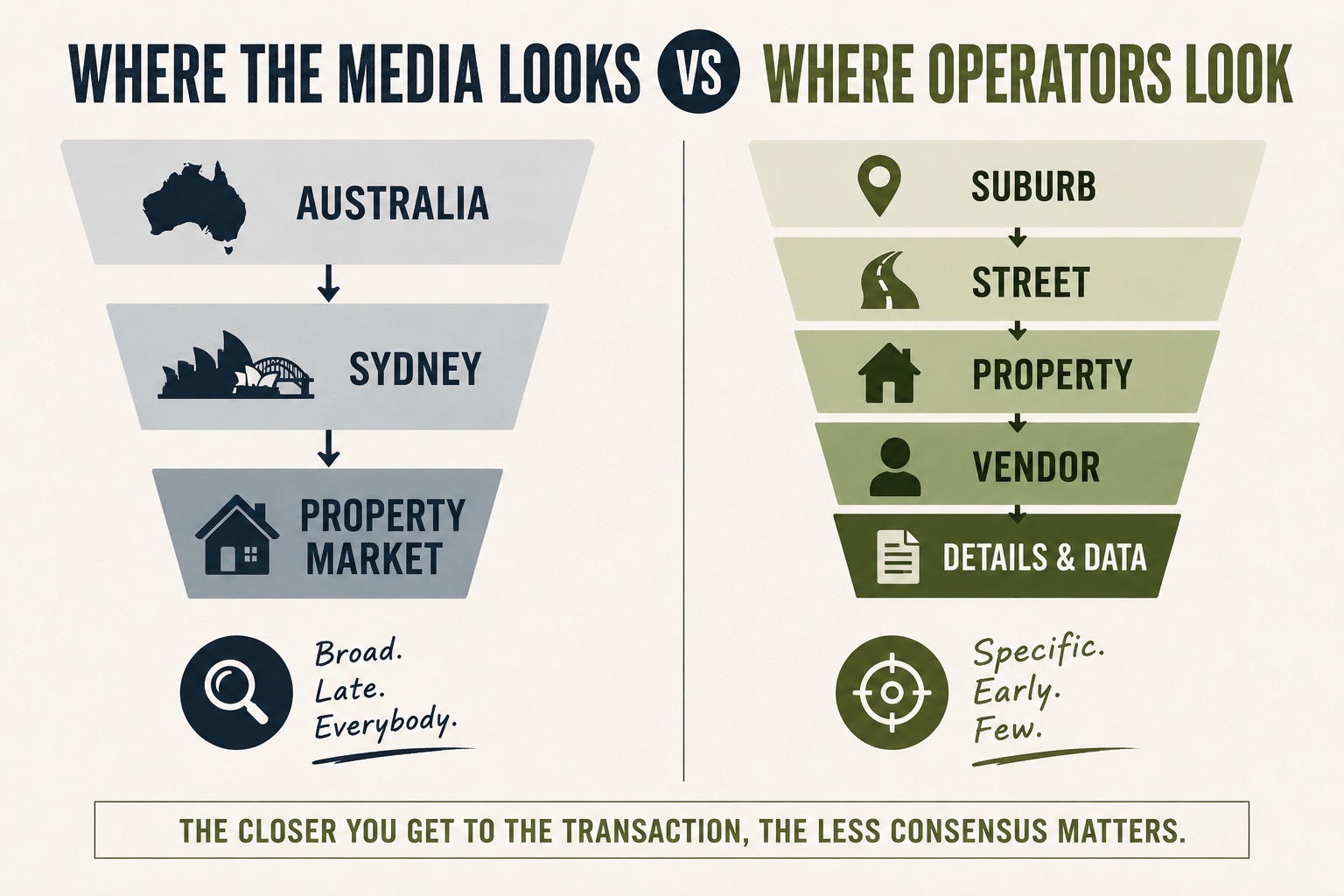
While commentators spent the week debating national prices, we spent ours looking at suburbs, streets, zoning changes, development applications, demographics and vendor behaviour.
Not because the future doesn’t matter.
But because today’s facts are usually more useful than tomorrow’s forecasts.
FREE SUBURB INTELLIGENCE REPORT
Email us at [email protected] with your suburb and we’ll send you a complimentary Suburb Intelligence Report covering:
✓ Growth pockets
✓ Street-level performance
✓ Development activity
✓ Demographics
✓ Schools and catchments
✓ Zoning and opportunity indicators
The headlines will debate what’s in stall for Australia.
The report will show you what’s happening in your suburb.
