The Property Crash That Isn't
Week ending Friday 22 May 2026
There's a phenomenon traffic engineers have studied for forty years and still can't fully eliminate.
It's called a phantom traffic jam.
No accident, breakdown or roadworks. Just a highway running at capacity, one driver taps the brakes, and the braking wave propagates backward faster than cars can clear forward. Ten kilometres back, someone sits in gridlock wondering what on earth caused it.
Nothing caused it. Everything caused it.
This is what is happening to the Australian property market right now.
The market is jammed.
The headlines this week can't quite decide what story to tell.
The AFR led with builders - describing a fresh wave of insolvencies as the fixed-price contracts signed during the HomeBuilder boom finally meet the Middle East fuel shock. Nearly 3,000 building companies went under in 2023-24, around 27% of all corporate failures nationally; the consensus now is that 2026 will deliver another wave on top of that, this time concentrated in builders who locked in 2024-25 pricing before the latest cost spike. An industry, as one trade outlet put it last week, "on its knees post-COVID and now waiting for the next blow."
Meanwhile, last week's Federal Budget changes proposing to abolish negative gearing , CGT tax concessions and introduce a 30% minimum tax on discretionary trusts has had every property accountant in the country furiously rewriting their client memos over the last week.
On a different note, banks have adjusted their serviceability calculators post budget which has left mortgage brokers now quietly telling buyers their borrowing capacity has dropped 20–30% on established-home purchases because the banks have stopped including negative gearing tax savings in serviceability calculations.
Then there's Cotality. Tim Lawless reports Sydney dwelling values fell 0.6% in April - the fourth monthly drop in five - sitting 1% below the November 2025 peak. Auction clearance has dropped to 51% against a long-run average of 64%. But entry-level Sydney property is up 2.9% year-to-date while the top quartile is down 3.3% - the squeeze on borrowing capacity is herding buyers downmarket and lifting prices at the bottom even as the top falls away. One economist is forecasting a double digit percentage drop in house prices over the next 12 months.
And underneath all of it: the RBA back at 4.35%, fully reversing the 2025 cuts, and minutes of the last meeting released this week warning of 5% inflation by June, and consumer sentiment is still in the doldrums despite a small post-Budget bounce.
It's not a crash. A crash has a direction, physics, clear cause and effect. This has no direction. It is congestion.
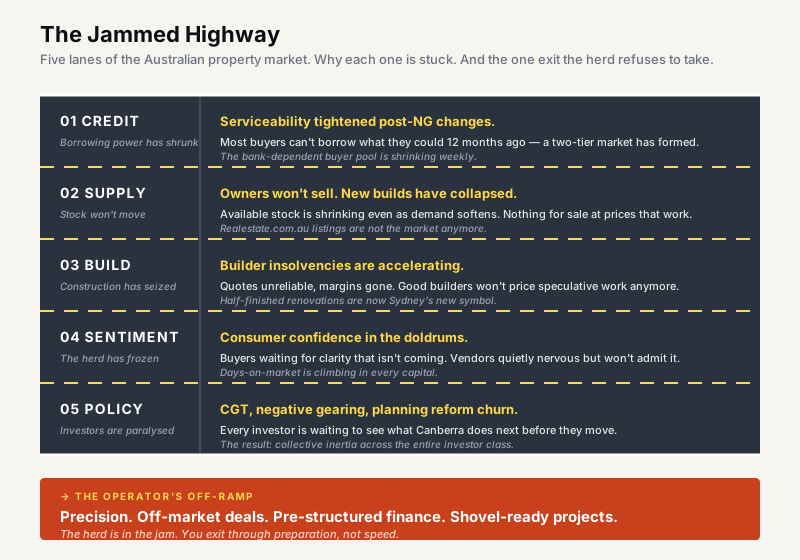
Buyers can't borrow enough. Sellers won't accept less. Developers can't feasibility-test their way to a deal that stacks up. Builders can't survive on the margins. Councils can't approve fast enough. The RBA can't cut without re-igniting the thing it just spent three years cooling.
Every lane is full. Nobody crashed into anything. Everyone just stopped.
How we got here (A brief detour through colonial India)
Indulge us for a moment.
British Raj, Delhi, late 1800s. The city has a cobra problem. The government, being a government, announces a bounty: bring in a dead cobra, get paid.
It works. Briefly.
Then enterprising locals start farming cobras for the bounty. The government, eventually catching on, cancels the program. The farmers, now holding worthless cobras, release them.
Delhi ends up with more cobras than before the bounty existed.
Economists call this the Cobra Effect. Historians, more grandly, call it the Law of Unintended Consequences. The pattern is older than both - Hanoi tried it with rats, the Soviets tried it with nail factories paid by weight (and got one enormous useless nail), the US tried it with Prohibition. Every time a clever fix meets a complex system, the system finds a way to make the clever fix look stupid. Housing policy is no exception.
It is, in fact, the textbook case. Consider the catalogue. First home buyer grants. Stamp duty concessions. Negative gearing. CGT discounts. Foreign investment rules. Planning protections. Lending restrictions. Builder licensing reforms. Each one solved a problem. Stacked together, they built a market where nobody can transact profitably at the margin - and the system has now seized on its own cleverness.
This is the phantom jam's cause. Not a villain. Just thirty years of cars merging onto the same highway.
What happens from here:
Three predictions. Hold us to them.
One: Prices don't crash. Transaction volumes do. The "median price" you read in the AFR will look surprisingly stable for the next 18 months. Underneath it, the number of homes actually changing hands will keep falling. A market that doesn't transact isn't a healthy market with stable prices. It's a frozen one wearing makeup.
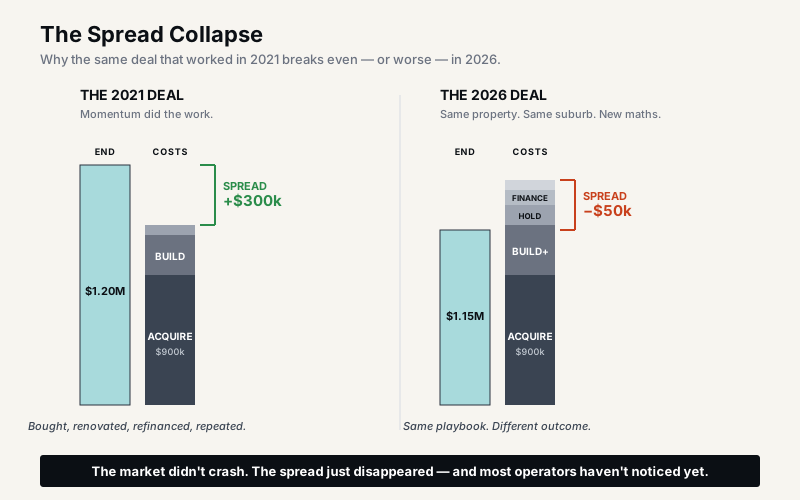
Two: The amateur "buy, reno, refinance" playbook dies. Not with a bang. But with a thousand spreadsheets that no longer add up. Holding costs, construction inflation, tighter end-buyer borrowing, slower approvals - the spread that used to make these deals work has been eaten alive. The people still doing it on instinct will lose money for two years before they realise.
Three: A small number of operators will make more money in this market than they did in the boom. Because there's nobody at the deal table. Vendors are negotiable for the first time in a decade. Builders are quoting sharply for anything shovel-ready - known scope, known timeline, cash in the door. Councils, drowning in fewer applications, are favouring operators who arrive with clean plans over speculators chasing uplift. The herd has parked. The road is empty for anyone who knows where they're going.
The operator's edge in a jammed market
In a phantom jam, the drivers who escape aren't the fastest or the boldest. They're the ones who read the system early and changed lanes before anyone else noticed there was a problem.
The same is true here. The edge is no longer momentum. It's precision.
Better buying - feasibility before falling in love. Numbers before narrative.
Tighter scopes - the days of "we'll figure out the budget as we go" are over. They were probably always over; the market just hid the bodies.
Funding structured before settlement - not after, not "we'll find the money." After is too late in a jammed market.
Realistic exits - modelled at today's serviceability, not 2021's.
Staged execution - so you're never holding the whole risk at once.
None of this is glamorous. Little of it will go viral on PropertyTok. All of it is what separates the operators who'll be richer in 2028 from the ones who'll be telling stories about the deal that "should have worked" — if not for the 2026 Budget changes, the war in the Middle East, the RBA, runaway inflation, take your pick.
The excuses won't be in short supply. None of them will bring anyone closer to the outcome they were after.
There's only one thing that does. Read the signs. Change lanes now. Take the off-ramp while the herd sits in the jam.
Two small things we made for you
We use two internal tools on every deal and in every strategy session. We've stripped them down into one-pagers you can actually use:
The Spread Test — six numbers, three red-line thresholds, and a 90-second walk-away test for any value-add deal in a jammed market. For when you're staring at a specific property and need to know if the numbers still work.
The Operator's Off-Ramp — a one-page map of the five jammed lanes (credit, supply, construction, sentiment, policy) and the exact operator move that exploits each one. For when you need to know where to be playing, not just whether a single deal stacks up.
P.S. If you know an operator who's still using the 2019 playbook in a 2026 market, do them a favour and forward this. The phantom jam doesn't care how confident you are.
