Don't Wait for the Crash
Week ending Friday 24 April 2026
Most flippers are on the sidelines eagerly waiting for the property market to collapse.
They intend to swoop when:
Prices fall.
Distress appears.
Opportunities become obvious.
That is how it is supposed to work in theory.
But in Australia time… the market never breaks. It’s tightens.
This headlines arrived in a neat little sequence this week.
First, the warning:
Australia is heading toward a fiscal cliff. Spending is locked in. Revenue isn’t keeping up. Something, we are told, will have to give.
Next, the escalation:
Inflation isn’t easing - it’s accelerating again. Pipes up 36%. Paint up 10%. Milk up 20%. Businesses passing on costs faster than anyone expected.
Then, the throwback:
Whispers of the 1970s return. Stagflation. Weak growth. Rising prices. No clean policy lever to pull.
And finally, the quiet one:
The banks begin preparing.
More provisions. More caution. Less appetite for risk.
On the surface, it reads like the beginning of a cataclysmic collapse.
But look closer, and something else appears.
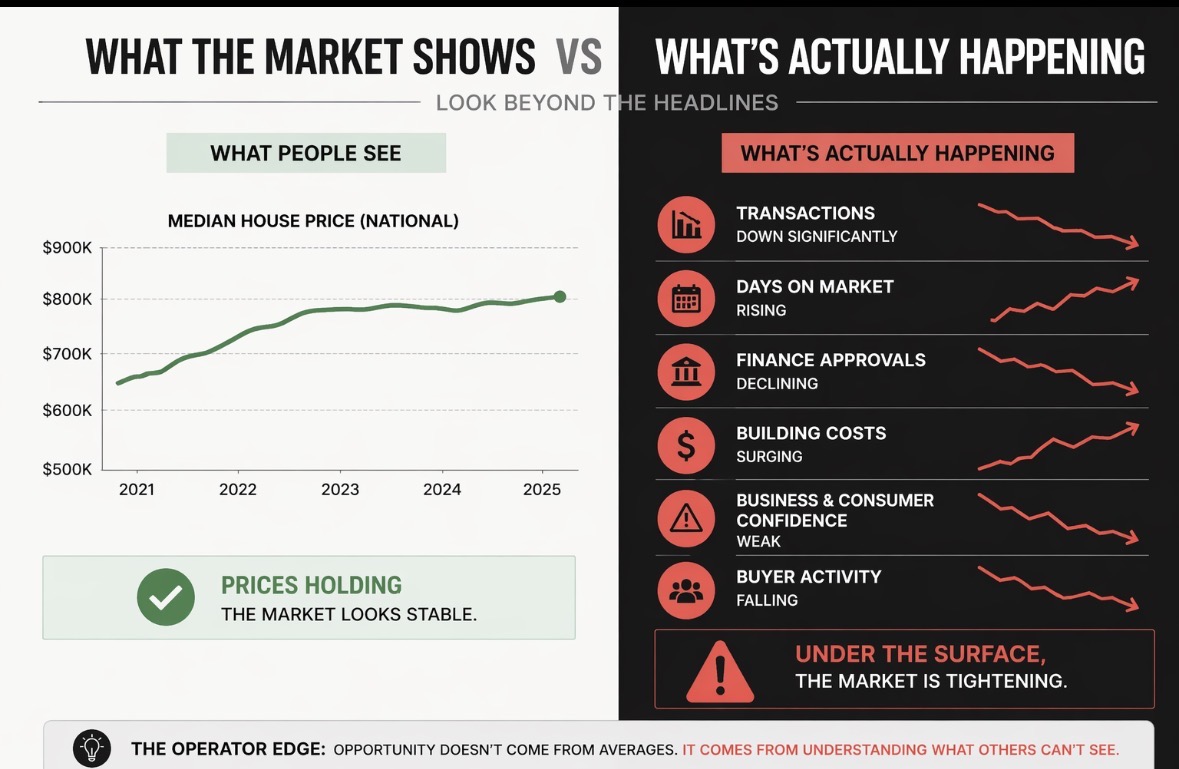
What the Market Shows… vs What’s Actually Happening
The System That Bends
Governments cannot cut spending meaningfully.
The RBA cannot raise rates without damaging growth.
Banks cannot take on more risk without consequences.
So the system does what systems like this always do.
It bends.
Pressure is not released. It is just stretched, delayed, and redirected.
And when it does surface… it doesn’t arrive evenly.
Nor is it felt that way.
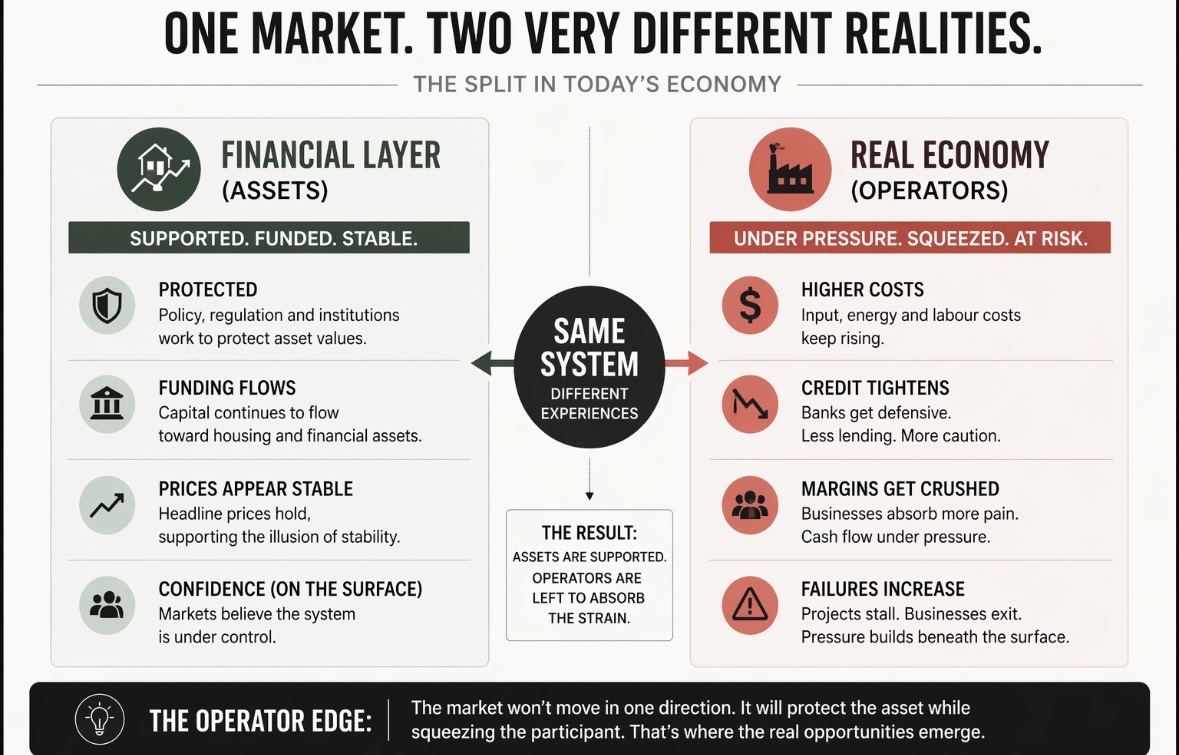
The Split
The system is now doing two opposing things at once:
It is supporting asset values…
while squeezing the people who operate within them.
Capital still flows toward housing.
Credit, however, becomes more selective.
Prices appear stable.
Transactions become harder.
From the outside, it looks like nothing is happening.
From the inside, everything is getting tighter.
One Market. Two Very Different Realities.
Why This Matters
Most participants are still waiting for clarity.
They are looking for a signal:
that prices have fallen
that rates have stabilised
that the “bottom” is in
But markets like this don’t announce themselves. No one rings a bell at the bottom of the market.
Instead it just thins out.
Fewer buyers.
More hesitation.
Longer timelines.
And in that thinning… pricing becomes inconsistent.
When Buyers Step Back…

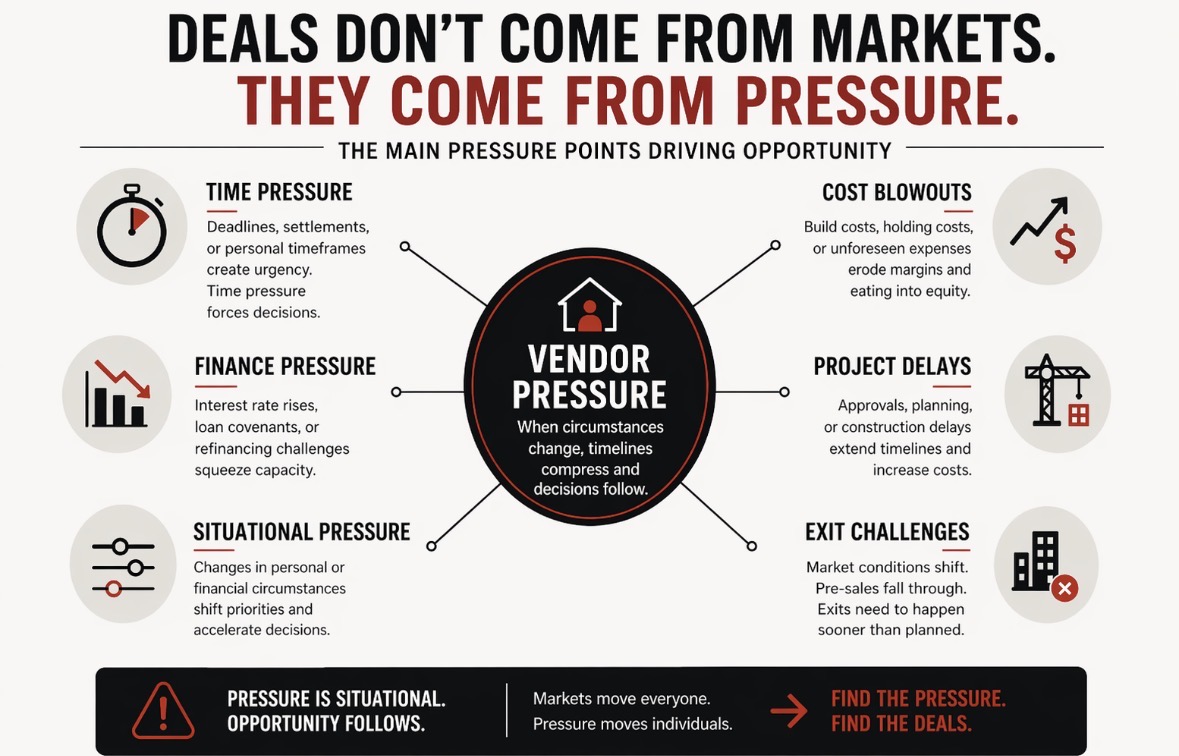
Where the Pressure Actually Shows Up
This isn’t something screamed in the headlines.
And it won’t be touted in the median price charts or in neat, national averages.
It shows up in smaller, less visible places.
A listing that sits longer than expected.
A builder whose costs moved mid-project.
A developer who assumed a clean exit that no longer exists.
A vendor who cannot wait another three months.
Individually, these don’t look like much.
Collectively, they are the market adjusting.
Deals Don’t Come From Markets
Where the Opportunity Sits
You won’t see this in some dystopian crash across the whole market. It is emerging now:
In pockets and in situations where:
time matters more than price
certainty matters more than upside
execution matters more than optimism
This is not a traditional buyer’s market.
It is something more selective.
A market where two properties can sit side by side…
and behave completely differently.
Operator Takeaway
Most people are still modelling a market that moves in straight lines.
This one doesn’t.
It moves in bursts.
It delays, then compresses.
It holds, then gives - but only in places.
That is where the edge is.
Not in predicting the market.
But in understanding how it actually behaves.
Conflict of Interest
There are forces at work here that don’t get much airtime.
World record migration supports growth - but it also adds pressure to housing supply.
Tax and policy levers exist - but they are unlikely to be deployed in a way that destabilises housing prices.
And the banks, sitting on large housing exposure by way of secured mortgages, are incentivised to preserve stability wherever possible.
So the system never resolves pressure by letting prices fall.
It resolves it by shifting the strain elsewhere.
