Markets Aren’t Bowling Balls
Week ending Friday 24 July 2026
There was no shortage of sobering news this week.
Australian mortgage rates are now among the highest in the developed world after the Reserve Bank’s three rate increases this year.
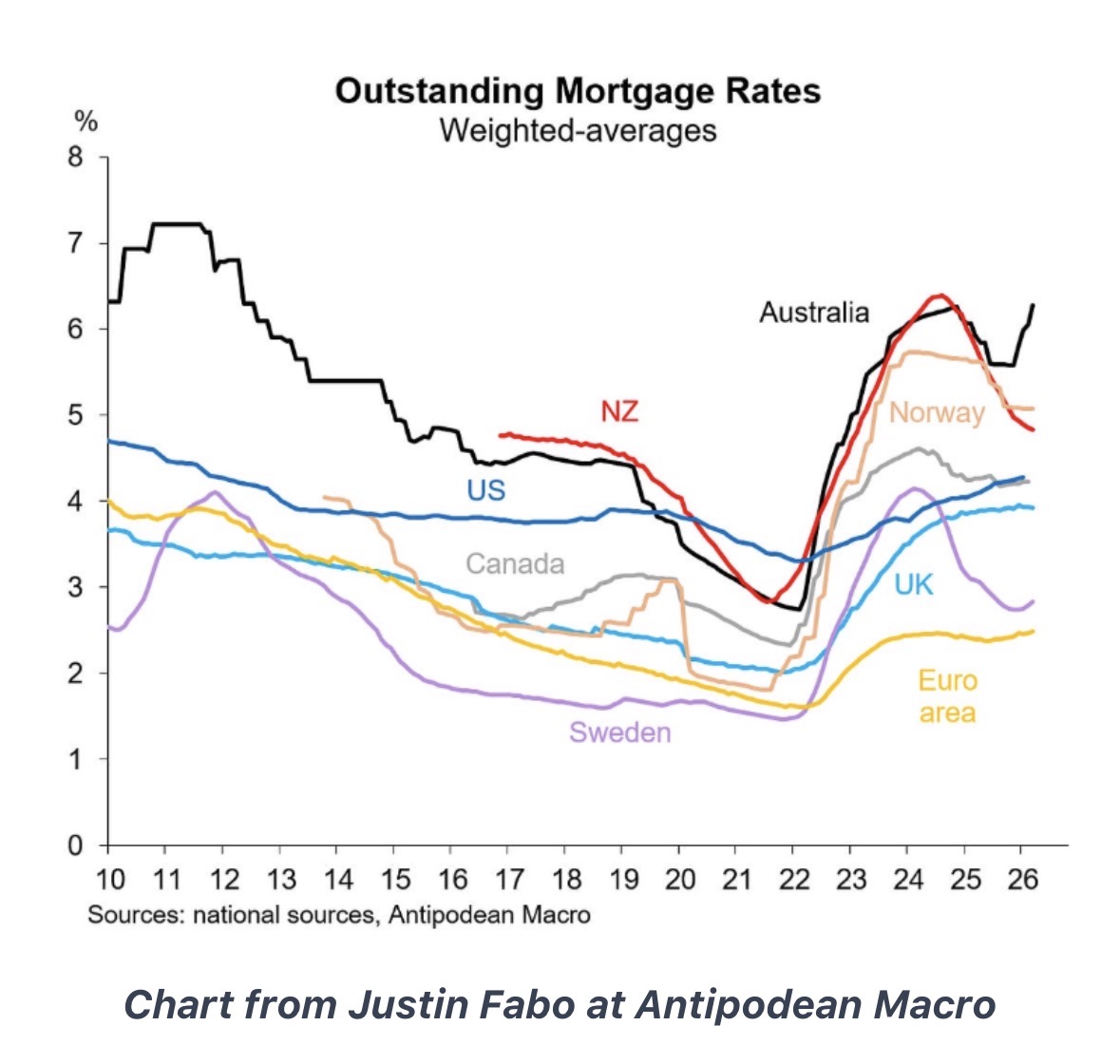
Roy Morgan estimates that 30.3% of Australian mortgage holders—around 1.6 million households—are now experiencing mortgage stress, matching the highest level recorded since the Global Financial Crisis. That’s 68,000 more households than a month ago and 115,000 more than a year ago.
The pressure may not be over. Financial markets are currently pricing around a 68% probability of another RBA rate increase before year-end.
The concern isn’t simply higher repayments.
Roy Morgan notes that unemployment has historically been the biggest driver of mortgage stress, and with unemployment already at its highest level since 2021, further labour market weakness could amplify the problem.
Meanwhile, Australia’s broader economic picture also deteriorated.
The ABS reported that real GDP per person fell another 0.1% in the March quarter, marking the tenth quarterly decline in fifteen quarters since mid-2022.
Westpac’s Leading Index weakened for the sixth consecutive month, with its six-month annualised growth rate slipping to -0.36%, a level broadly consistent with economic activity stalling through the middle of the year.
Employment indicators are also softening.
The NAB employment index has fallen sharply, suggesting businesses are becoming more cautious about hiring as higher interest rates work their way through the economy.
Productivity remains Australia’s longer-term challenge.
Labour productivity growth has been among the weakest in the OECD over the past decade.
Real household disposable income has barely grown.
Former RBA Governor Philip Lowe recently described stagnant living standards as “the fundamental economic problem the country faces”, arguing that Australia’s capital investment has failed to keep pace with population growth.
Even the Federal Budget came under scrutiny.
Economists questioned whether long-term projections relied on assumptions that may prove difficult to achieve.
Among them:
NDIS spending growth slowing dramatically.
The Federal Public Service shrinking despite a larger population.
Infrastructure grants declining in nominal terms over the next decade while Australia continues to grow.
Whether those assumptions ultimately prove correct remains to be seen.
But they illustrate just how much economic forecasting depends on expectations about future behaviour.
The Year 7 Economy
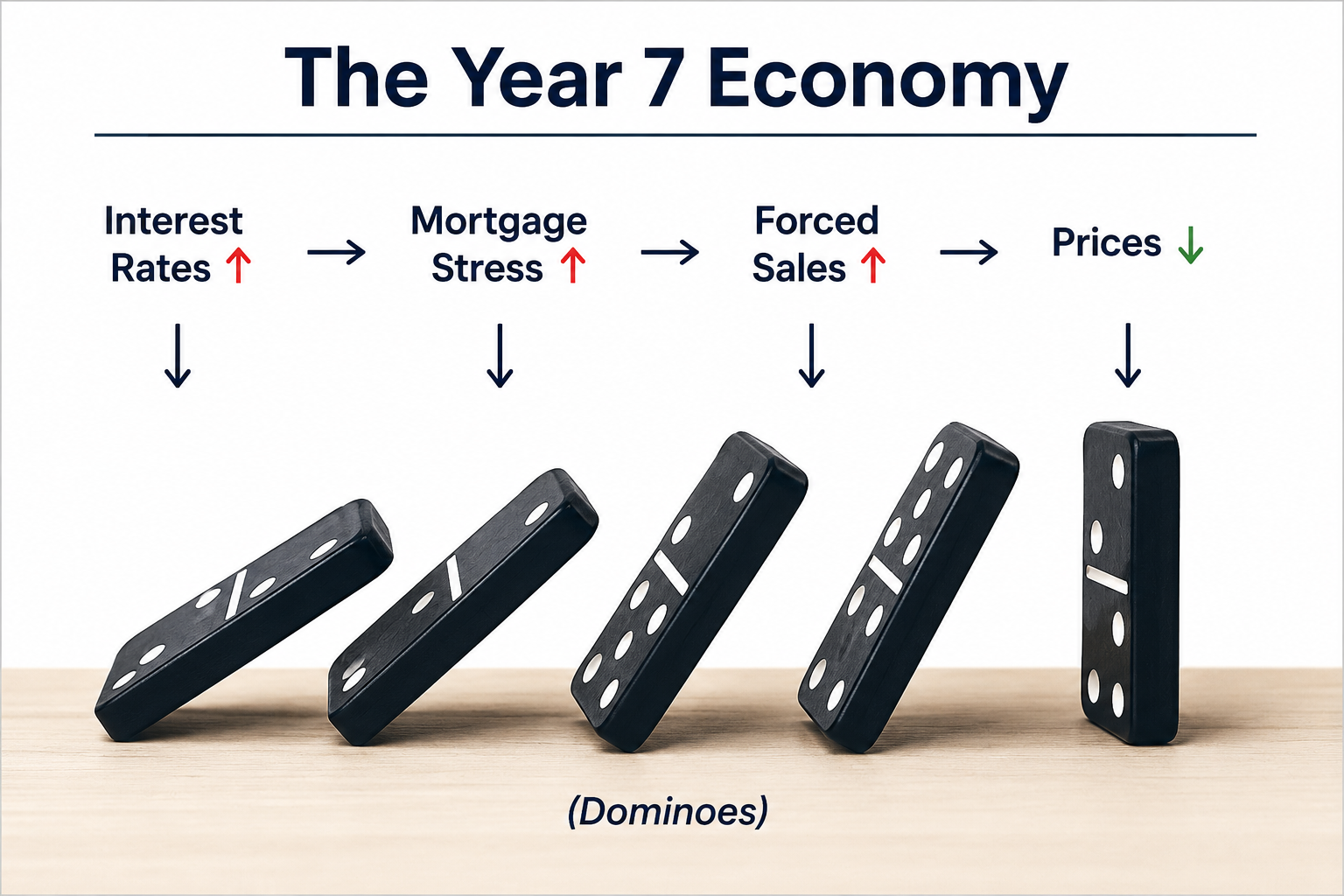
After reading those headlines, it’s easy to construct a simple story.
Higher interest rates.
↓
Mortgage stress.
↓
Forced sales.
↓
Falling house prices.
↓
Buying opportunities.
It feels logical.
In fact, most of us first learnt economics this way.
Cause.
Effect.
Cause.
Effect.
Almost like a row of dominoes.
The Economy Isn’t Physics
The challenge is that economies don’t behave like machines.
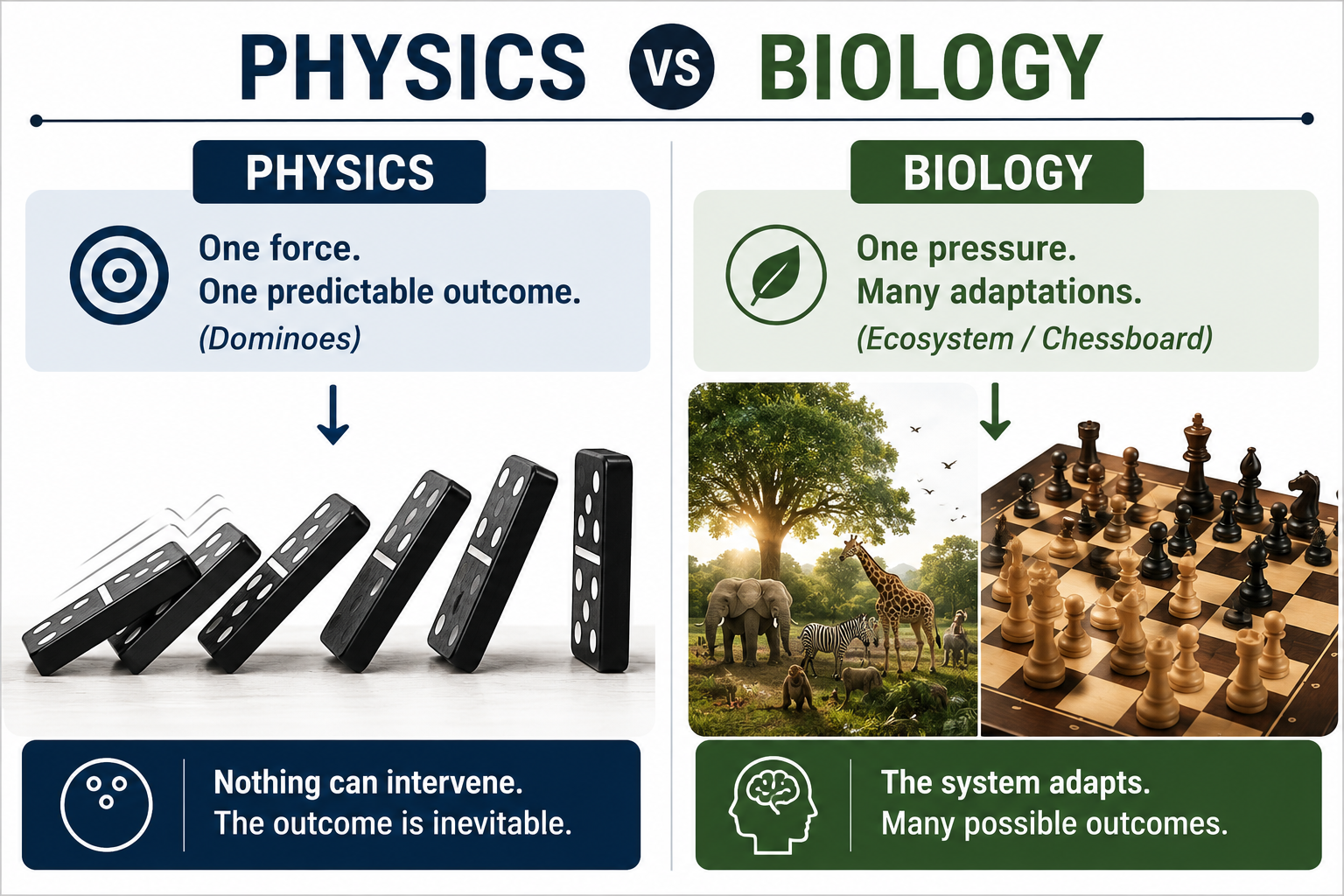
Physics is wonderfully predictable.
Drop a bowling ball from a rooftop and, all else being equal, gravity determines the outcome. The bowling ball doesn’t change its mind halfway down. It doesn’t negotiate. Nothing inside the ball alters its path. The outcome and trajectory is almost inevitable.
Push a domino and the same thing happens. Once it begins to fall, the outcome is pretty certain. The domino can’t adapt. The next domino can’t step aside. Nothing in the chain responds to what’s happening.
Living systems though are very different.
Apply pressure to an ecosystem and it responds, adapts and evolves.
Imagine a virus enters a population.
The virus changes.
People change.
Some isolate.
Others don’t.
Some are naturally resistant and others have prior immunity.
A portion will get vaccinated.
The immune system learns.
The virus mutates.
Doctors change treatments.
Governments change policy.
Behaviour changes because people observe what’s happening.
The system responds to the pressure.
The pressure itself changes because the system responded.
That’s biology.
Exactly the same initial event can produce very different outcomes because every part of the system is adapting at the same time.
Economies are made up of people, businesses, banks and governments - all motivated to and capable of changing course when conditions change.
That’s why forecasting markets is fundamentally different from predicting the path of a bowling ball.
Physics predicts what happens when nothing can respond.
Economics tries to predict what happens when everyone can.
Mortgage stress rises.
Some households sell.
Others refinance.
Another group cut discretionary spending.
Or rent out a room.
Some receive help from family.
Others simply decide not to sell.
The same pressure produces different responses.
The same is true for property businesses.
Higher interest rates don’t just reduce demand.
Developers postpone projects.
Builders slow construction.
Banks tighten lending.
Investors reassess risk.
Governments adjust policy.
Each decision changes the environment facing everyone else.
By the fifth or sixth response, the economy no longer resembles the neat chain of cause and effect we started with.
Thinking Three Moves Ahead
This is where many investors get frustrated.
Mortgage stress is at post-GFC highs.
The economy is slowing.
“Where are all the bargains?”
They’re looking for the first-order consequence.
But operators look for the second-order consequences.
They don’t ask:
What happens next?
They ask:
And then what?
Yes, and then what?
Three moves ahead.
Like chess, every move changes the board.
Every response creates another response.
Good operators don’t bet everything on one forecast.
They think in scenarios.
Because the edge rarely comes from predicting the first move.
It comes from anticipating the second… and preparing for the third.
The Operator’s Lens
Operators don’t ignore the headlines.
Quite the opposite.
They read them carefully.
Mortgage stress matters. As does productivity., economic growth, consumer confidence and budget forecasts.
But then they ask a second question.
“How will people respond?”
Because that is where forecasts become markets.
Not in the event itself.
In the adaptations that follow.
Instead of asking:
“Will prices fall?”
Operators ask:
How will borrowers respond?
What will sellers do?
How will builders react?
What are banks likely to do next?
How will governments respond?
Those answers determine what happens next.
Perhaps that’s the biggest difference between an economist and an operator.
Economists build models from relationships.
Operators build decisions from behaviour.
The economy is not a machine operating under the laws of physics.
It’s a living system.
One that constantly adapts.
And that’s why the best opportunities rarely appear at the beginning of the story.
They emerge several moves later, after everyone has had a chance to respond.
