The Elephant In The Room
Week ending Friday 26 June 2026
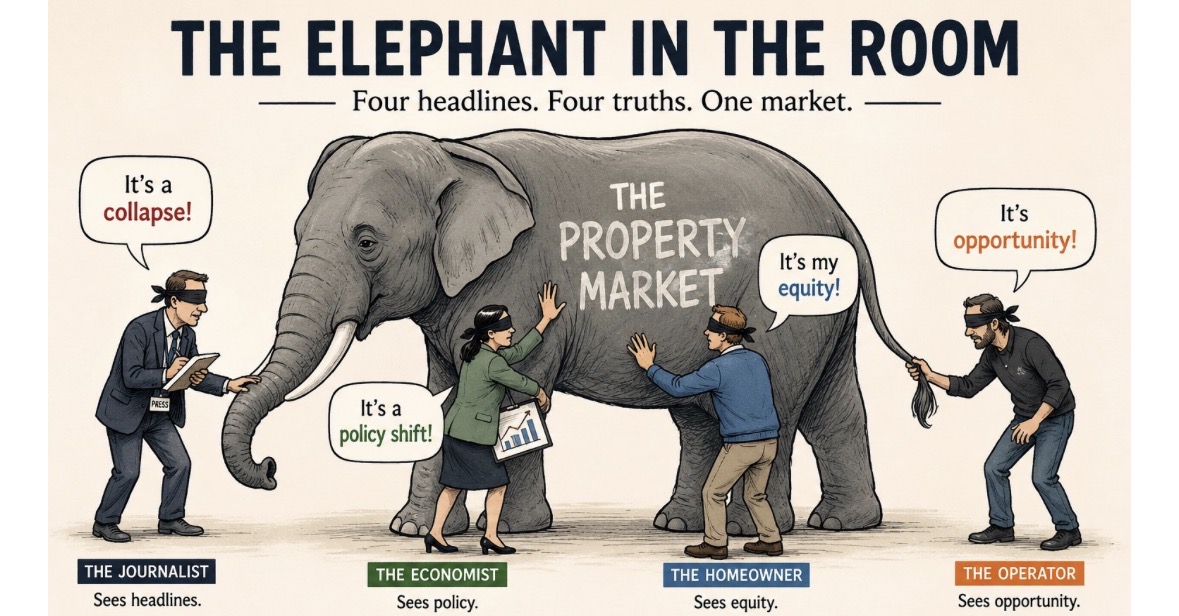
Four headlines. Four truths. One market.
This week Australia’s property market seemed to have an identity crisis.
One headline declared Sydney and Melbourne were in a severe downturn.
Another reported homeowners were making record profits.
A third suggested investors were falling out of love with property after the Federal Budget.
A fourth cited auction clearance rates at their lowest since the pandemic.
At first glance, at least three of those stories had to be wrong.
But they weren’t.
There’s an old story about four blindfolded people who are led to an elephant and asked a simple question.
“What are you touching?”
The first reaches out and grabs the trunk.
“It’s like a giant snake.”
The second feels one of the elephant’s legs.
“No. It’s like a tree.”
The third runs their hands across the elephant’s side.
“You’re both wrong. It’s a wall.”
The fourth picks up the tail.
“It’s obviously a rope.”
None of them is lying or imagining things.
And none of them is wrong.
They’re simply mistaking their perspective for the whole picture.
Property markets are much the same.
Every week journalists, economists, homeowners and buyers describe the market from the part they’re touching. Their conclusions often sound contradictory because they’re measuring different things.
The mistake is assuming any one of them tells the whole story.
The better question isn’t:
“Who’s right?”
It’s:
“What part of the elephant are they describing?”
THE FOUR TOUCHPOINTS
Every perspective has value.
Each is simply answering a different question.
📰 The Journalist
Question: What happened this week?
Journalists report change.
Their job is to explain today’s movement.
📊 The Economist
Question: Why is this happening?
Economists focus on interest rates, tax, migration, supply and policy.
They explain the forces shaping and moving the market over time.
🏡 The Homeowner
Question: What happened to my property?
Homeowners naturally look backwards.
That’s why falling prices today can exist alongside stories about record profits.
They’re measuring different points in time.
🎯 The Operator
Question: What has changed that creates opportunity?
Operators look beyond prices.
They look for changing behaviour.
Longer days on market.
More flexible vendors.
Fewer competing buyers.
Better negotiating conditions.
Different question.
Different answer.
WHAT WE NOTICED
Almost every article this week focused on prices.
Prices falling.
Prices correcting.
Profits growing.
Profits shrinking.
But prices are usually the last thing to change.
Behaviour changes first.
Before prices soften, vendors become more flexible.
Before markets recover, buyers quietly regain confidence.
Before the media notices opportunity, negotiations start happening behind the scenes.
Markets don’t turn on a particular day.
They turn one conversation at a time.
A good example this week was auction clearance rates.
The simple reading is:
Clearance rates are falling, therefore prices must fall.
Maybe.
But that is only one part of the elephant.
A falling clearance rate does not automatically mean every seller folds and meets the market.
Some will.
Some will negotiate earlier accepting strong pre-auction offers.
Others will withdraw and re-list later or perhaps rent the property instead, especially in suburbs where vacancy is tight and rents are strong.
Agents may suggest avoiding auction altogether and move to private treaty or expressions of interest.
That is why operators need to think beyond the first-order conclusion.
The headline says:
Auction clearance rates are falling.
The operator asks:
What behaviour is changing underneath that number?
Are vendors becoming more negotiable?
Are agents encouraging early offers?
Are listings being withdrawn?
Are properties being passed in and quietly repriced?
Are vendors in low-vacancy suburbs choosing to hold and rent rather than sell?
That is where the opportunity sits.
Not in the number itself.
In the behaviour behind the number.
A clearance rate tells us what happened on auction day.
It does not tell us the full strategy of the vendor, the agent or the buyer.
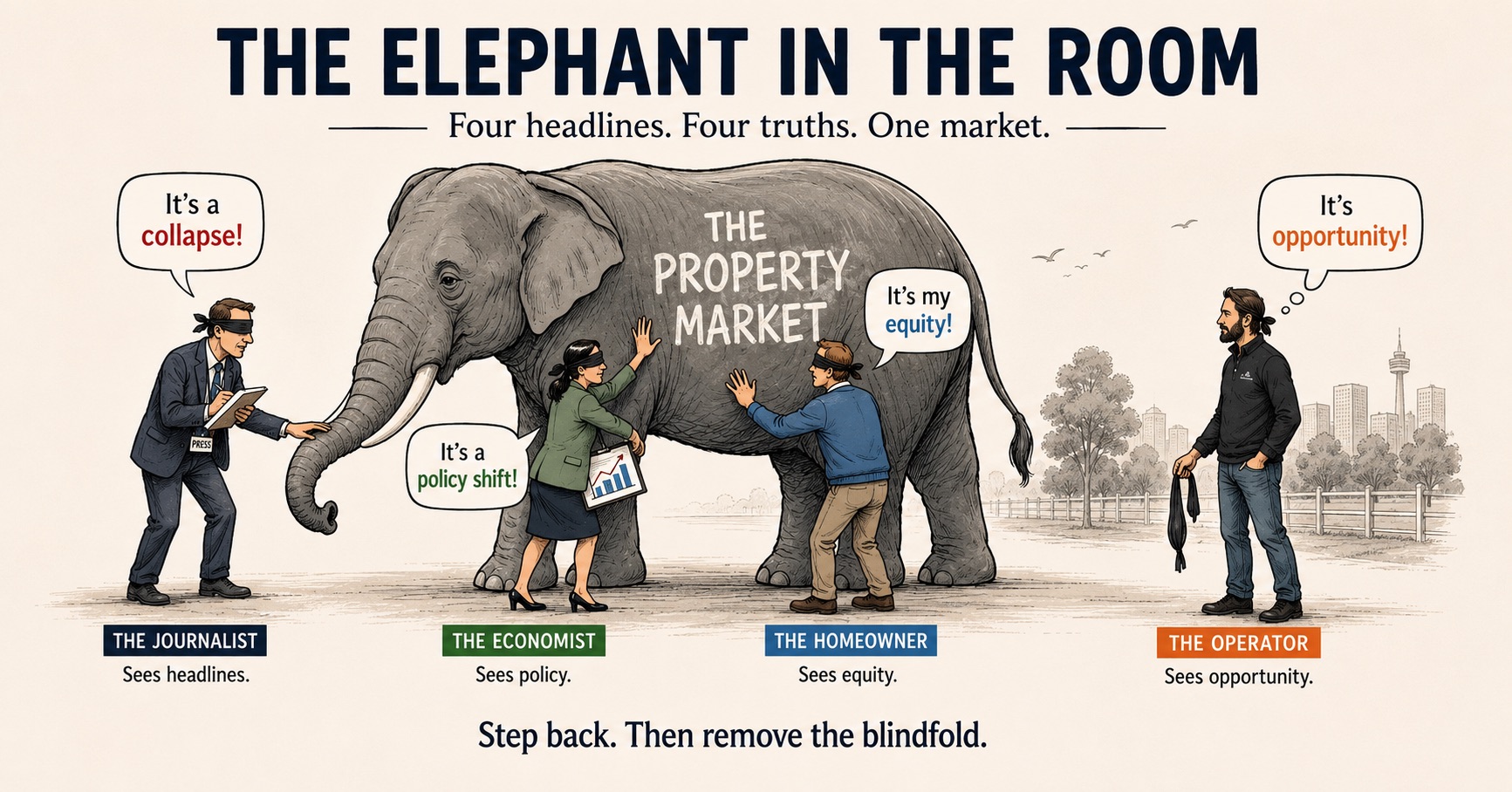
To see that, you have to step back.
FROM THE BALCONY
The best operators know when to stop participating… and start observing.
Imagine you’re both the actor on the stage and the person sitting quietly in the balcony.
The actor sees only the next move.
The person in the balcony sees the entire play.
They notice the action and story.
All the actors.
The whole scene - including the set and the ensemble
The audience reactions.
Property flipping is no different.
The best decisions rarely come from reacting faster.
They come from stepping back far enough to see what everyone else is missing.
TAKE OFF YOUR BLINDFOLD
Every decision begins with a question.
The quality of your decision depends on the quality of that question.
Most buyers ask:
“Is the market going up or down?”
But what problem are you really trying to solve? Operators ask better questions.
Who is actually buying in this suburb?
What are they willing to pay for?
What won’t they buy?
Are vendors becoming more negotiable?
Is supply increasing or tightening?
Where are the risks?
Where is the opportunity?
If I buy, renovate or flip here, who is my buyer at the end… and what will they pay?
Those aren’t questions a headline can answer.
They’re not questions an agent can answer.
And they’re certainly not questions answered by a median price or an auction clearance rate.
The answers only become clear when every piece of the puzzle is brought together.
That’s Why we designed our suburb reports to bring together all the signals that matter into one objective view of a suburb.
The report shows you what is happening on the ground at a street and pocket level and the interpretation explains what it means and why it matters.
Together, they help you step back, remove the blindfold and see the whole elephant.
THIS WEEK’S MISSION
Open a Suburb Report for a suburb you’ve been considering.
Forget the headlines, the agent’s talk track and the median price.
Instead, ask the right questions that matter.
Then step back and look at the market as a whole.
Because great operators don’t make better decisions by collecting more opinions.
They make the right calls because they see the whole picture.
THE OPERATOR’S QUESTION
Whose answers are shaping your decisions?
The headlines?
The crowd?
Or the market itself?
The blindfold isn’t ignorance.
It’s mistaking your perspective for the whole picture.
P.S. If your Proptix trial has expired, simply email [email protected] with ELEPHANT and we’ll restore your access so you can generate fresh Suburb Reports and see the market through a different lens.
