Confidence: Australia’s Invisible Interest Rate
Week ending Friday 31 July 2026
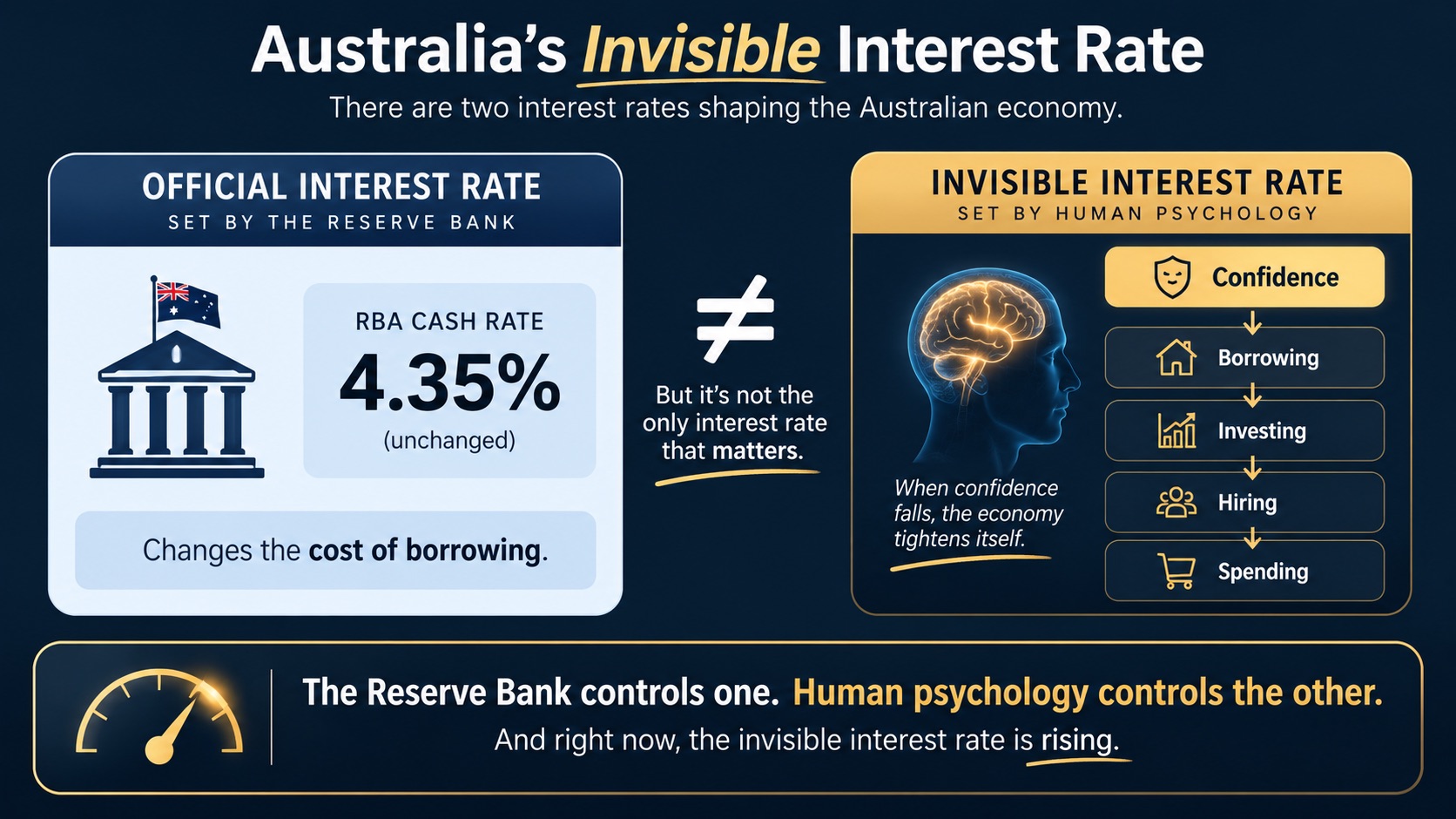
The Reserve Bank controls one interest rate. Human psychology controls the other.
“Markets don’t freeze when opportunities disappear.
They freeze when confidence does.”
The headlines this week
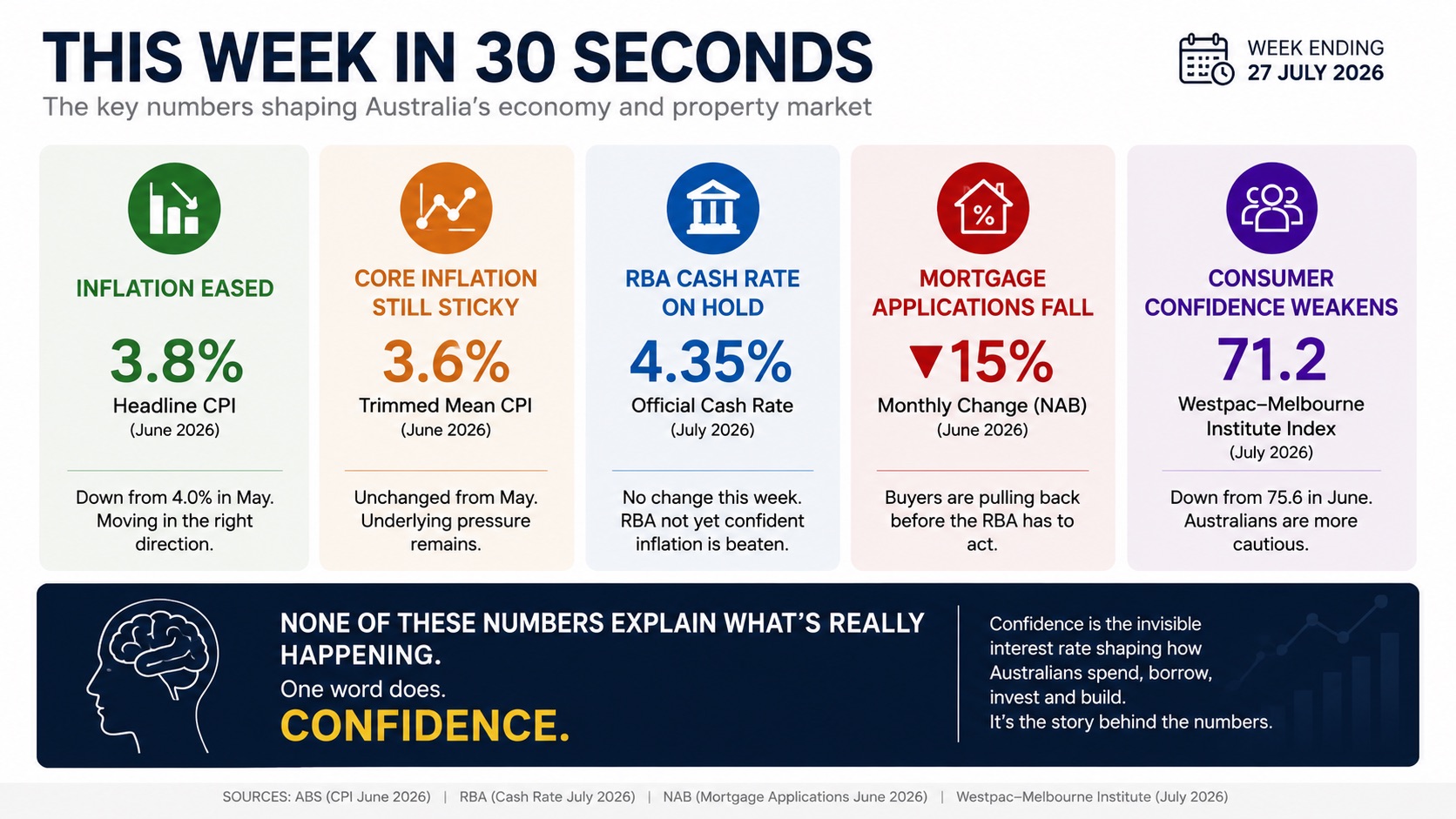
If you only read the headlines, this week looked relatively uneventful.
Inflation eased again.
Markets reduced the probability of another interest rate increase.
The Reserve Bank remained cautious.
Buyers remained hesitant.
Property activity continued to soften.
Nothing particularly dramatic.
Yet beneath those headlines lies a much bigger story.
Not about inflation or interest rates.
But about us.
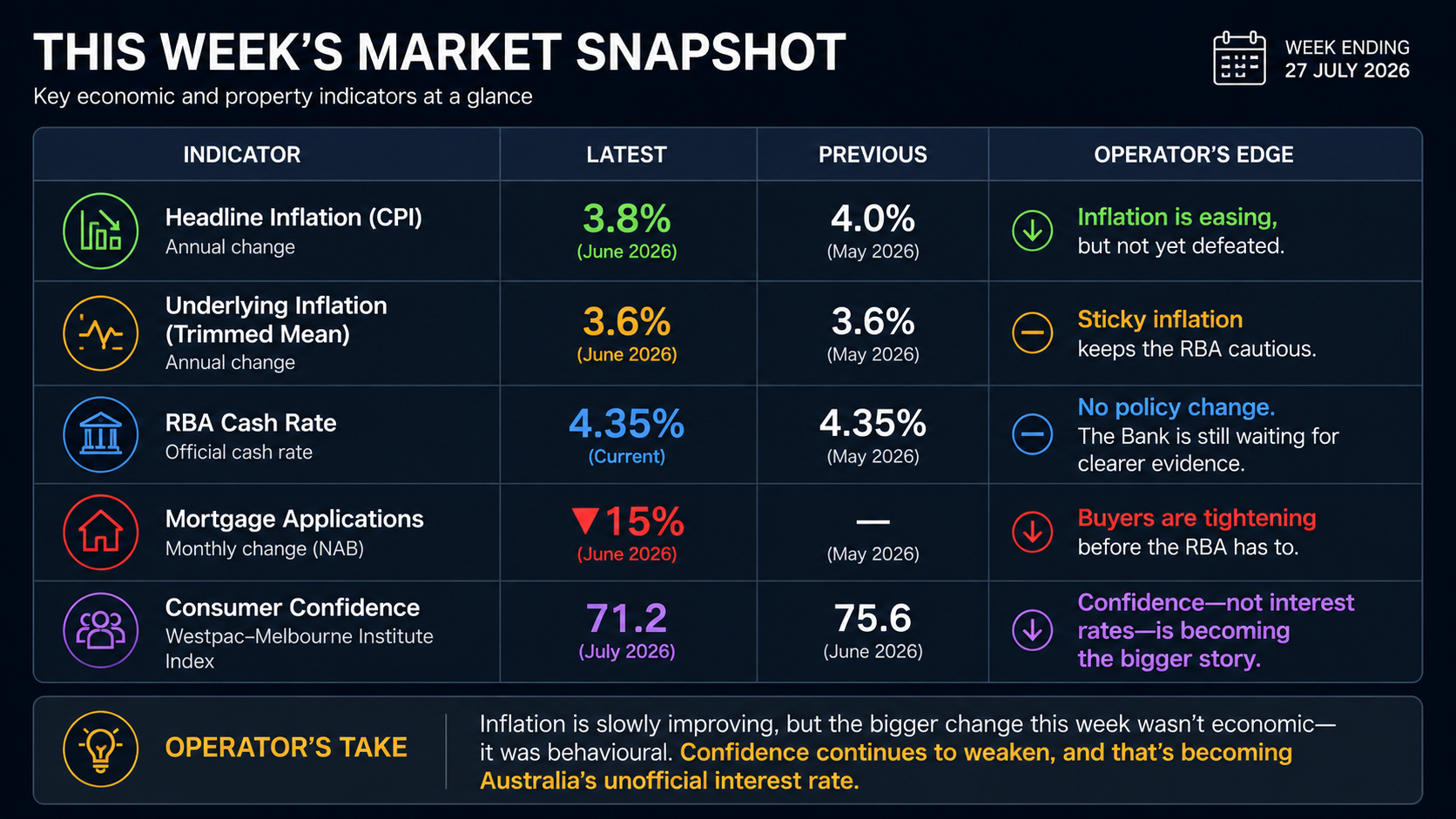
Market Snapshot
Michelle Bullock’s message
Reserve Bank Governor Michele Bullock struck a measured tone this week.
Yes, inflation is moving in the right direction.
No, the Reserve Bank isn’t declaring victory.
Underlying inflation remains stubborn enough that policymakers are reluctant to signal an early return to lower interest rates.
Which is perfectly reasonable.
But maybe the Reserve Bank is not currently the biggest influence on the Australian economy.
Perhaps confidence is.
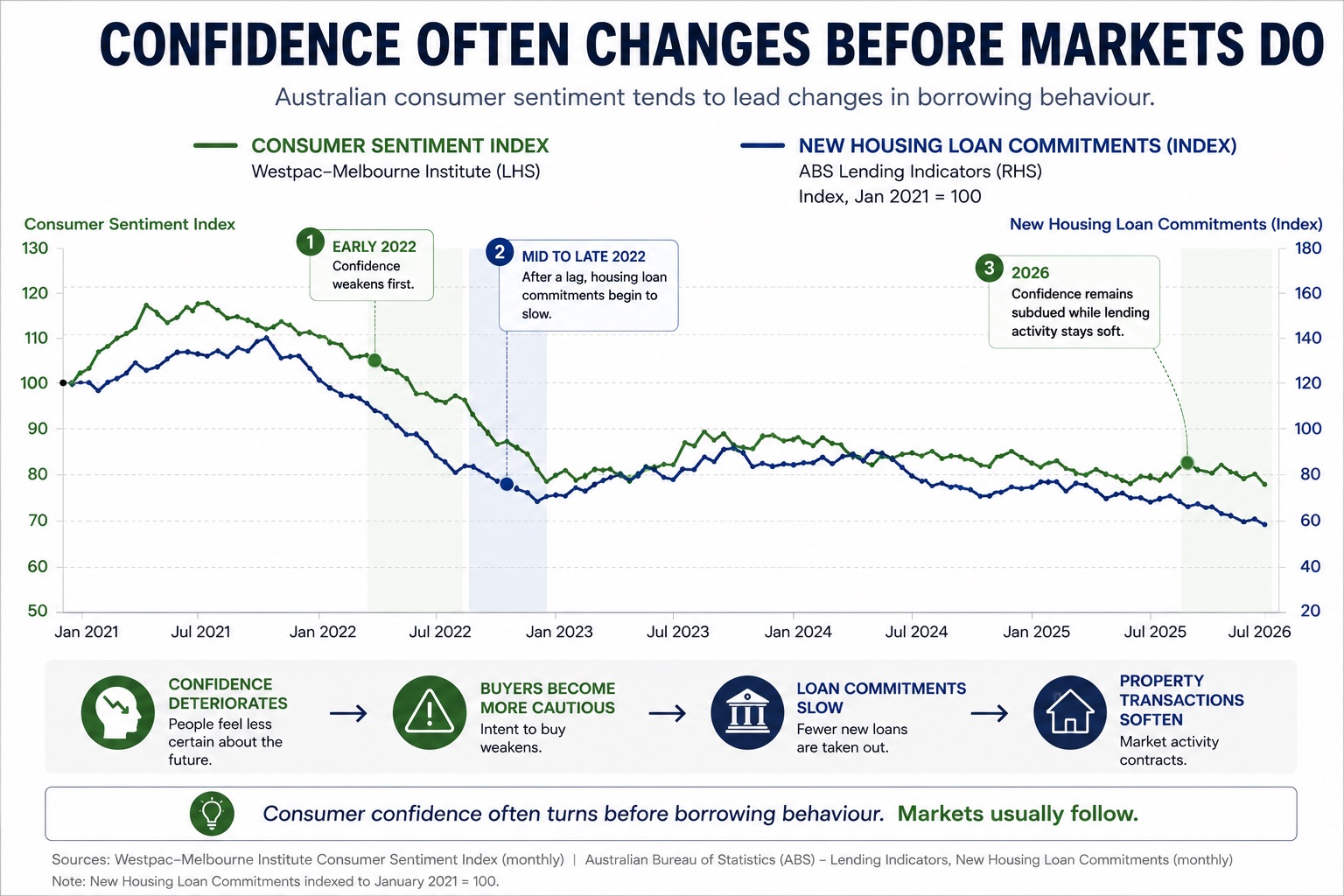
Fear has become Australia’s invisible interest rate.
Every time confidence falls…
Borrowing slows.
Wallets close.
Renovations wait.
Expansion pauses.
Hiring freezes.
Capital stays on the sidelines.
Not because interest rates rose necessarily but because behaviour changed.
The economy begins tightening itself.
Most people think markets move because of economic changes.
In reality…
Markets move because people change.
And people don’t make decisions like economists.
They make decisions like humans.
Humans don’t calculate first.
They feel first.
Then justify it later.
Behavioural economists have spent decades proving something most experienced operators already know.
We are not rational creatures.
We’re predictably irrational.
Loss Aversion
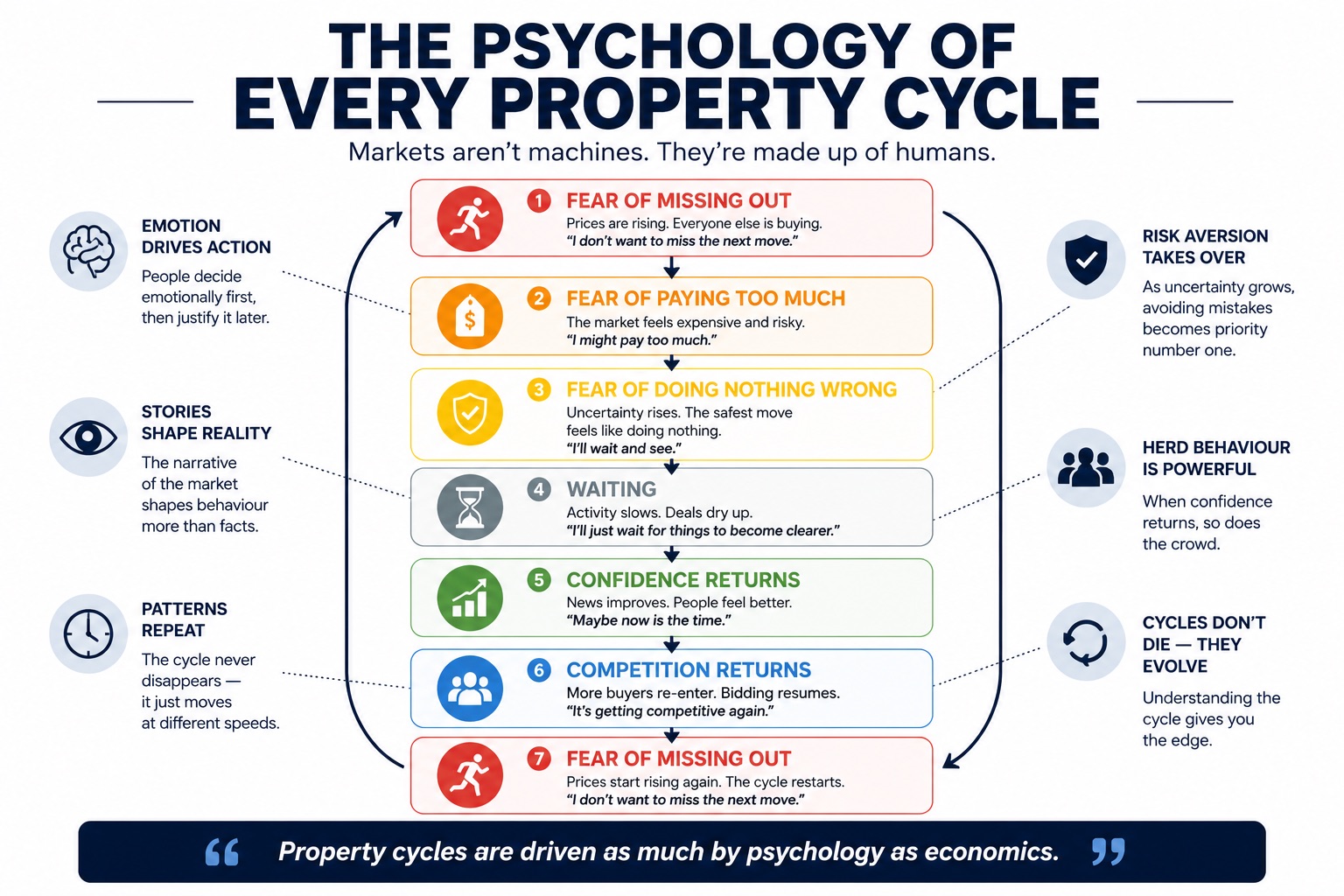
Research consistently shows that losing $100 hurts roughly twice as much as gaining $100 feels good.
That single insight explains almost every property cycle.
During boom times…
People fear missing out.
During uncertain times…
People fear making a mistake.
One is driven by greed.
The other by regret.
Regret usually wins.
Negative Bias
Our brains evolved to notice danger.
Bad news receives more attention than good news.
One article predicting recession outweighs ten articles showing resilient employment.
One weak auction suddenly becomes “proof” the market has turned.
The facts haven’t necessarily changed.
The story people tell themselves has.
Confirmation Bias
Once someone believes property is going to crash…
Every headline seems to confirm it.
Every price reduction becomes evidence.
And every slow auction in turn then reinforces the belief.
Meanwhile…
People expecting prices to rise do exactly the opposite.
Both groups think they’re reading the market.
Often, they’re simply reading themselves.
Cognitive Dissonance
One of the quirks of human psychology iscognitive dissonance - the discomfort we feel when our beliefs, emotions and actions don’t line up.
Rather than changing our behaviour, we often change the story we tell ourselves.
For example people may say:
“I’ll buy when prices come down.”
Prices come down. But then the goalposts get moved:
“I’m waiting to see what happens.”
The market removed the obstacle.
The mind simply replaced it.
Once fear takes hold, new facts don’t necessarily change behaviour. Instead, the brain looks for a new explanation that justifies the feeling that was already there.
The emotion sticks and dictates the decision and then the reasoning and justification follow.
Houses don’t buy houses.
People do.
Markets aren’t collections of buildings.
They’re collections of decisions made by humans.
Millions of them.
At every auction.
Across every negotiation.
In each refinance.
With every delayed purchase.
In the renovation that never begins.
In the development approval left sitting in a drawer, waiting “until things improve.”
The market isn’t an abstract machine.
It’s a mirror reflecting collective human emotion driving behaviour.
Which brings us to operators.
It is pointless trying to predict a market by looking at lagging indicators like interest rates. The mood of the market tells you what is going on. Ask instead “How are people feeling?”
Because that’s where opportunity lives.
When everyone becomes fearful…
Competition falls.
Negotiating power increases.
Creative deal structures become possible.
Motivated sellers become easier to identify.
Opportunities don’t disappear.
They simply become less crowded.
Operator’s Edge
The headlines this week were about inflation.
The bigger story is confidence.
Because confidence behaves like an invisible interest rate.
It doesn’t appear on an RBA statement.
And you won’t find it in the ABS data.
But you can see it every day in auctions…
Open homes…
Finance approvals…
Business investment…
And conversations around the dinner table.
Markets aren’t governed by physics.
They’re governed by people.
And people don’t always act logically.
They act emotionally.
The operators who understand psychology don’t just understand markets better.
They understand why everyone else is making the decisions they are.
And that’s where the real edge has always been.
